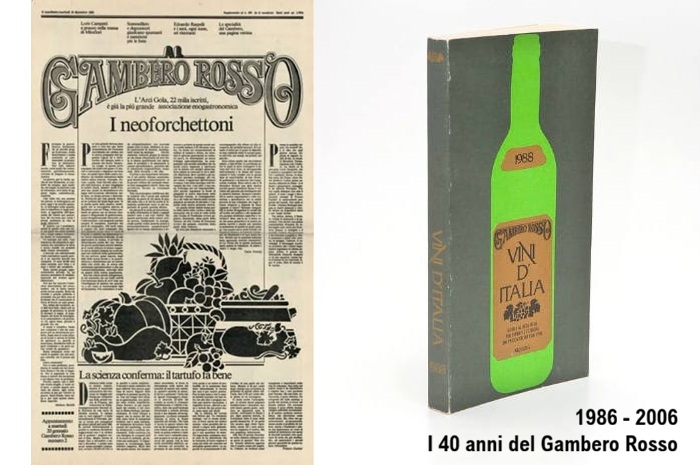
Of the 47 years I have spent working in the wine industry, half of them were spent playing an important role at Gambero Rosso, to which I therefore owe a great deal. On the occasion of this publication’s 40th anniversary, I’d like to revisit what I wrote in the book *Memorie di un Assaggiatore di Vini* (*Memoirs of a Wine Taster*), published by Einaudi Stile Libero in 2006. It recounts how the magazine came to be, who its founders were, and its pioneering days, when it was a supplement to the daily newspaper *Il Manifesto*. It also mentions Stefano Bonilli and Carlo Petrini, who are no longer with us, and serves as a way to remember them.
I wrote this in 2006, marking Gambero’s 20th anniversary:
At Gambero Rosso
Between my job as a teacher at school, the wine-tasting courses at the Italian Sommelier Association — where I’d been teaching since 1980. And my contributions to a few magazines, I wasn’t doing too badly. But the big break was yet to come. It wasn’t so much about success or money. It was simply the desire to have my say in a field where I thought—wrongly, as it turned out—that I had it all figured out.
One day in November 1986, I received a phone call at home. It was Stefano Bonilli, a former journalist and rising star at *Il Manifesto*, the very famous communist daily. He had recently been forced to leave RAI along with the entire editorial staff of *Di Tasca Nostra*, a consumer advocacy television program hosted by Tito Cortese. The program had been taken off the air following a lawsuit filed by a well-known food company that had taken issue with the results of a test. Bonilli had returned to his old passions and had proposed to the editors of the newspaper where he had worked for nearly fifteen years that they produce a monthly consumer supplement.
A monthly supplement focusing on food and wine
The newspaper’s editors replied that he could go ahead, but that it shouldn’t cost the newspaper anything. He set to work. After all, he was no stranger to the world of food and wine. He had been a regular at Peppino and Mirella Cantarelli’s restaurant in Samboseto, near Parma, which was perhaps the first to offer ingredients of exceptional quality, simple preparations, and a stellar wine selection. In this regard, one of his articles, titled “Discussing with Cantarelli” which appeared in *Il Manifesto* in the 1970s, and was somewhat modeled after an interview with Rossana Rossanda, founder and maîtresse à penser of the newspaper, had titled “Discussing with Althusser.”
The comparison had seemed disrespectful. Putting one of the most famous Marxist thinkers on the same level as the culatello from Zibello didn’t sit well with everyone, to put it mildly. But this time he really had a chance to redeem himself, so he set to work.
For a Handful of Professionals
Contact Piergiorgio Maoloni for the graphic design—a genius in the field who, sadly, passed away recently. And put together a small team of collaborators. Among them were Cristina Barbagli, a nutritionist and biologist. A leading expert in comparative food testing. And Edoardo Raspelli, a feisty food critic from Milan, the bane of restaurateurs for his sometimes scathing reviews.
We needed a wine expert. It was Raspelli himself—who had met me a few years earlier—who suggested to Bonilli that he contact me, and that’s exactly what he did.
The name, Gambero Rosso, came about for three main reasons.
- It was the tavern where Pinocchio was swindled by the Cat and the Fox; our publication aimed to defend consumers—and thus all the Pinocchios out there.
- Was the most common name among Italian restaurants and trattorias, and we would have covered those topics as well.
- It was a difficult time for the Italian left, which was losing ground in the elections just like a crab, and we were publishing in *Il Manifesto*.
Gambero Rosso adventure began exactly that way
The first editorial office was on Via Tomacelli—where *Il Manifesto* is still located today. And consisted of half a desk that Bonilli shared with another editor. He could use the chair and the phone, but not the typewriter. The typewriter was on a small table with no chair, so to type. We’d stack the phone books on top of each other to sit on.
Bonilli owned a powder-blue Fiat Uno 45 S, which he later sold to me. I had a Bordeaux-colored Panda 30, more to give myself an air of being a wine connoisseur than out of any real appreciation for the color. We both had very little money and a lot of hope. So we threw ourselves passionately into the work. I knew *Il Manifesto* only from having read it a few times as a student. And I couldn’t have foreseen that the launch of a food-and-wine supplement in that newspaper would stir up the uproar that followed.
First of all, it must be said that it was by no means true that all the readers of that newspaper were aligned with and supportive of its political stance. Il Manifesto was and is read by the entire political spectrum. By a large part of the economic and financial sectors, and also by many people on the left who were not at all scandalized by what we wrote. Moreover, at that time there was very close collaboration with the fledgling Arcigola— now known as Slow Food, and with its charismatic founder Carlin Petrini.
The Central Role of Wine
Wine has always been one of Gambero Rosso’s central topics, ever since its very first issues. I remember that we were the first in Italy to introduce ratings in cents, as was done in the United States.
Then, in the spring of ’87, during a meeting at the Arcigola headquarters in Bra, we came up with the idea of create a full-fledged guide to Italian wines. Carlo Petrini and Gigi Piumatti were there representing Arcigola, while Bonilli and I were there on behalf of Gambero Rosso. Veronelli’s *Bolaffi* hadn’t been published for a few years, and at that time there was no publication to take up the mantle. So we got started.
The Origin of the “Three Glasses”
The wines needed to be classified, and a scoring system was required. Rating them on a scale of hundredths seemed too difficult and questionable to us. Then I had an idea. On average, one bottle yields six glasses of wine, and it’s very sad—not to mention unhealthy—to drink it all by yourself. A bottle is meant to be shared by at least two people, and if the wine is very good, then you’ll finish it. And you’ll each have three glasses. Well, the best wines should therefore have a rating of three glasses. Two that were a little less good, one that’s at least worth trying, and none that really convinced us.
It seemed like a little game, yet that rating system—perhaps precisely because of its immediacy and simplicity—was a resounding success, so much so that today the term “three glasses” or “three-glass wine” has become part of the everyday vocabulary of countless wine enthusiasts, and not just in Italy. That’s what it means to have taught in middle school…
A Reference Guide
At first , *Vini d’Italia*— that was the guide’s name—caused a stir mainly because a group of people who wrote for *Il Manifesto* were focusing on quality wines. Then, little by little, it grew in both credibility and readership, and in nearly twenty years it has become the go-to publication in the world of Italian wine.
Doing this every year isn’t easy. The wines change, and harvest conditions vary, so it has to be completely rewritten each time. And each time it takes at least five months to conduct all the tastings and evaluate what is now more than 15,000 labels. It’s a massive undertaking, made possible by the dedication of over one hundred collaborators, coordinated by myself and Gigi Piumatti of Slow Food.
This is because the real revolution in driving was the establishment of tasting committees throughout Italy. Rather than having just one or a few people shoulder the burden of evaluation. In short, it is a democratic guide that does not depend on the whims or convictions of a single editor-in-chief.