


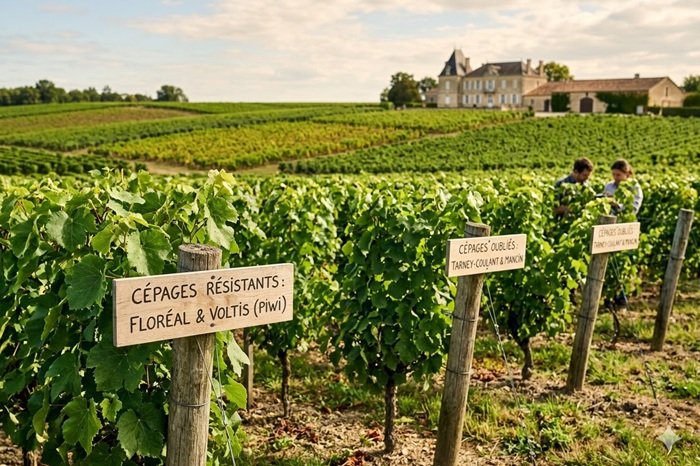

What is changing in French vineyards? Between resistant vines, forgotten varieties and old hybrids, some French winemakers are questioning the traditional varietal heritage. A phenomenon recounted by Le Figaro that opens an inevitable question: what about in Italy? Stefania Vinciguerra tells us about it.
Names are appearing in French vineyards that until a few years ago no one would have imagined reading on a label: Floréal, Voltis, Artaban, Vidoc. These are not new wine brands, but grape varieties.
According toa recent article published by Le Figaro, more and more French winemakers are beginning to plant unknown or forgotten varieties, among resistant vines, ancient varieties that have been recovered and even hybrids that were once forbidden. More than an ampelographic curiosity, it is a sign of a transformation that could affect one of the pillars of French viticulture over time: The relationship between territory and grape varieties.
Underlying these are very concrete factors: climate change, increasing pressure on pesticide reduction, and the need to make vineyards more sustainable. But there is also a deeper issue behind these agronomic choices, which concerns the identity of French wine itself.
The push for resistant grape varieties
The prime mover of this change is the so-called PiWi, the cépages résistants, varieties obtained through crosses between Vitis vinifera and other naturally more disease-resistant vine species. Their goal is to drastically reduce treatments against Downy mildew and powdery mildew, two of the main challenges of European viticulture.
In a context where environmental pressure on pesticide use is increasing-and where the climate is making the phytosanitary balance of vineyards more unstable-many researchers and producers see resistant one of the possible answers for the future of viticulture..
The return of forgotten varieties
Alongside the new crossings, another phenomenon is also developing: the recovery of so-called cépages oubliés, the forgotten grape varieties.
After the phylloxera crisis in the late nineteenth century, Europe’s varietal heritage was gradually simplified. Many local varieties were abandoned in favor of a smaller number of vines considered more productive or more reliable. Today, however, some winemakers and researchers are rediscovering this earmarked assets. In regions such as the Southwest or Languedoc, nearly vanished vines have been recovered, often found in old vineyards or ampelographic conservatories.
This is not just a matter of historical memory: many of these varieties show useful characteristics even today, such as good climatic adaptability, late ripening or original flavor profiles.
The hybrid taboo
The third, more sensitive issue concerns the possible return of the French-American hybrids.
Grapes such as Clinton or Noah were banned in France in 1935 because they were considered qualitatively inferior and unsuited to the standards of European viticulture. For decades they remained on the sidelines of the winemaking debate. Today, however, some producers and researchers wonder whether these varieties-often very hardy and resistant – cannot play a role in a viticulture that must increasingly reduce treatments.
The issue remains controversial because it touches on one of the cultural pillars of French viticulture: the primacy of the Vitis vinifera and historical grape varieties.
The node of designations
In fact, the real problem is not only agronomic, but also cultural.
French viticulture is based on the system of the AOC, which closely links territory and varieties grown. Each appellation determines precisely which grape varieties can be used. This makes any varietal innovation particularly delicate. It is no coincidence that many of the new resistant grape varieties are grown mainly in PGI or Vin de France, categories that are more flexible than traditional appellations.
France is thus faced with a paradox: it must innovate for environmental and climate reasons, but the innovation risks undermining one of the foundations of its wine-growing model.
So what about Italy?
Looking at Italy, the situation looks different. Here, too, resistant grape varieties are gaining space, especially in the northeastern regions-Trentino-Alto Adige, Friuli-Venezia Giulia and Veneto-where varieties such as Solaris, Bronner, Johanniter, Fleurtai or Soreli are already present in several vineyards.
However, the Italian context is different. In fact, Italy possesses One of the world’s greatest ampelographic biodiversity, with hundreds of registered native grape varieties. This means that adaptation to climate change can also come through the recovery or enhancement of existing varieties.
In other words, while France debates whether to introduce new grape varieties, Italy often finds that it already has an extraordinary genetic wealth at its disposal.
A transformation that affects all of European viticulture
The phenomenon recounted by Le Figaro is therefore not just a curiosity, it is a sign of a broader transformation affecting all of European viticulture. In recent years, in fact, resistant grape varieties have been gaining ground in several countries, especially in Germany, Switzerland and Austria, where experimentation began much earlier.
Between climate change, sustainability, and the rediscovery of biodiversity, vineyards are entering a new phase of experimentation. For more than a century, European wine was identified with a relatively small number of iconic grape varieties. Today that certainty is beginning to waver.
The question that emerges is simple but radical: will the great wines of the future still come from the same varieties as yesterday? or from those we are just beginning to learn about today?

