
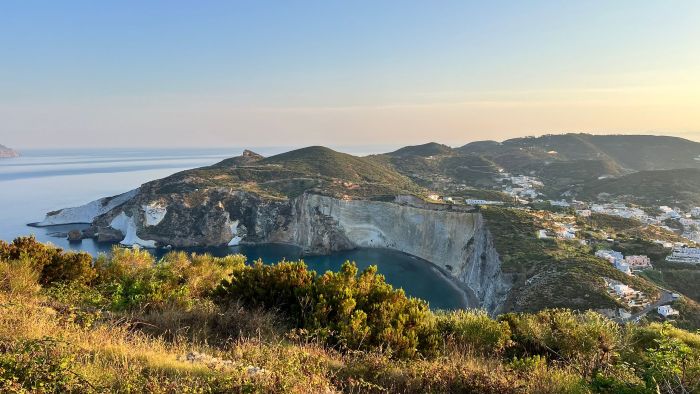

In Fieno, amid volcanic terraces and trails traveled on foot or by mule, Antiche Cantine Migliaccio preserves the island’s “heroic” viticulture and captures its Mediterranean character in the glass.
Anyone familiar with Ponza immediately thinks of the sea. It’s inevitable: as soon as you arrive at the harbor, you’ll understand why it’s considered one of the most beautiful islands in the Tyrrhenian Sea.
There is, however, a lesser-known side of Ponza, far from the coves and boats, that continues to thrive on the terraces of the village of Fieno. It is here that the vineyards of Antiche Cantine Migliaccio are located, a cornerstone of the island’s viticulture for many years.
We are guests of Emanuele Vittorio, 86, and Luciana Sabino, 80, the owners of the winery, and Vincenzo Mercurio, the winemaker who has been working alongside them for many years now. Emanuele and Luciana are a very close-knit couple, incredibly warm people with whom it’s a pleasure to spend time. You can immediately sense that the relationship between them and Vincenzo goes far beyond a professional collaboration: mutual respect, friendship, and a shared vision of wine, always grounded in respect for the land.
On the evening of our arrival, we taste the winery’s wines together. It’s a moment just as special as the visit to the vineyards the following day. Listening to Emanuele, Luciana, and Vincenzo talk about Ponza, its viticulture, and their wines allows us to immediately get a feel for the spirit of the winery.
The Road to Fieno
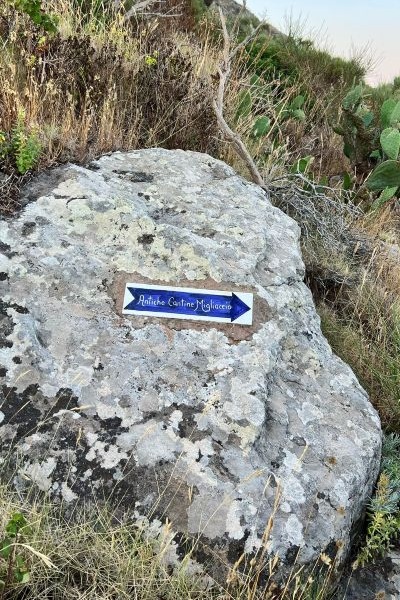
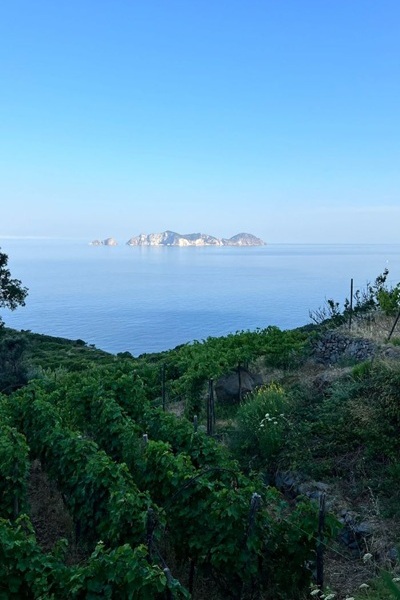
The next morning, the alarm goes off at five. It’s the best way to tackle the climb to Fieno before the sun makes the route much more challenging.
To get to Fieno there are no cars or roads suitable for vehicles.
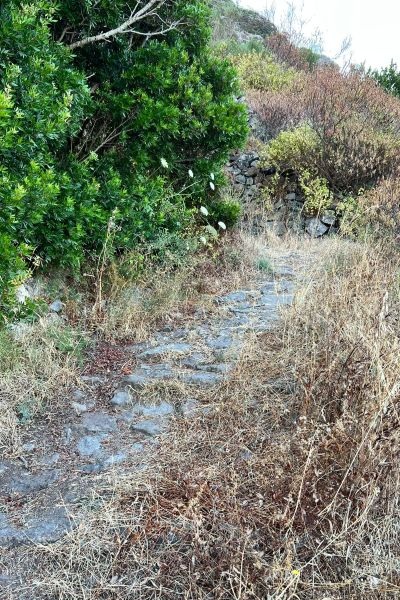
It’s about a forty-minute walk along a trail that requires proper shoes and a basic level of fitness. Those who work these vineyards make this trek every day, back and forth. When heavy materials need to be transported, they still rely on mules.
It is a detail that speaks volumes about what it means to grow grapes in this place.
Then the trail opens up, and the scenery more than makes up for the effort.
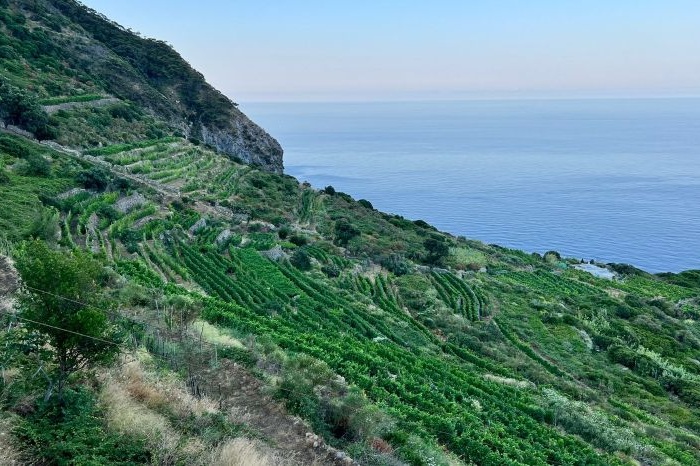
Right before my eyes, a little corner of paradise. Terraces stretch along the slope, supported by ancient dry-stone walls built stone by stone. In many places, volcanic rock emerges among the vines. The mountain plunges toward the sea, and the Mediterranean constantly borders these vineyards.
Even from the sea, this place is not easy to reach. There are no safe landing spots or “official” mooring spots. The village of Fieno seems almost as if it wants to defend its beauty, revealing itself only to those willing to earn it.
The Sea Within the Vineyard
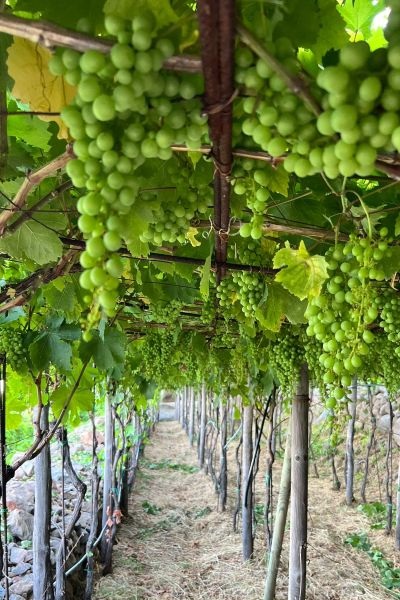
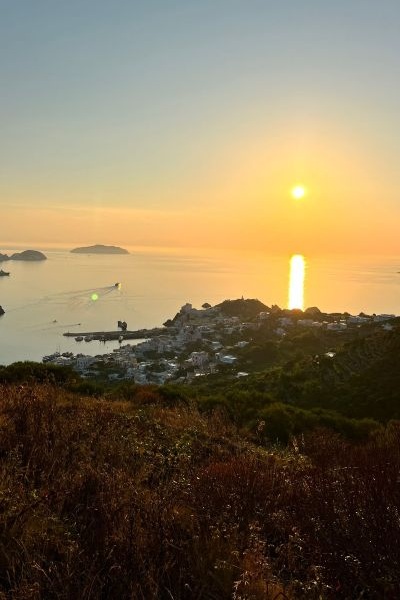
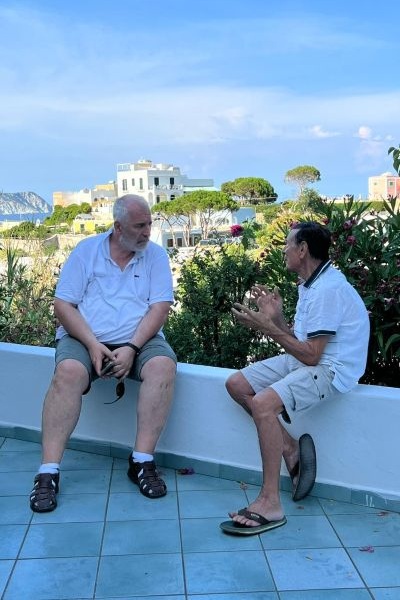
Once we reach the vineyards, Vincenzo Mercurio guides us through the terraces, explaining the work he does throughout the year and his approach to winemaking. Every decision, whether in the vineyard or in the winery, stems from respect for this extraordinary place and a desire to preserve its identity intact.
This isn’t your typical vineyard with a view of the sea. Here, the sea is part of the vineyard.
The light reflected off the water, the constant breeze, the sun, the volcanic soil, and the Mediterranean climate accompany the vine throughout its entire growing cycle. Walking among these rows, one realizes just how much the terroir contributes to the character of the wines.
And this comes through clearly in the glass. These are wines that speak of the sea. This is neither a catchphrase nor a romantic notion. After tasting them several times over the years and finally visiting Fieno, the impression is even clearer: they convey the essence of the Mediterranean with surprising naturalness.
The Campania Grape Varieties of Ponza
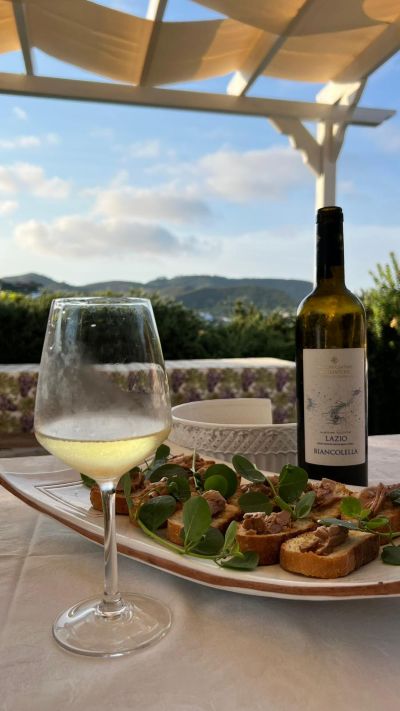
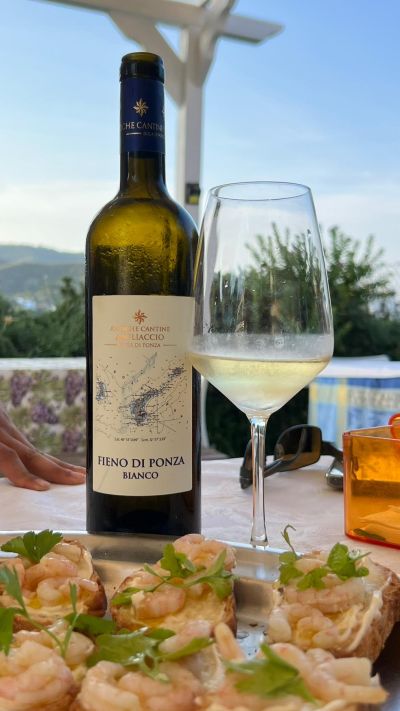
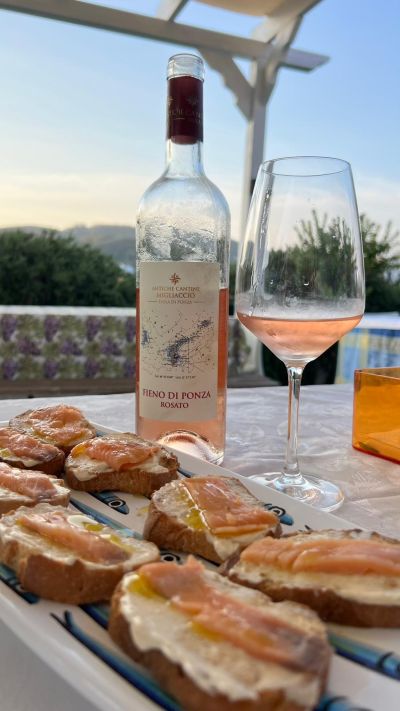
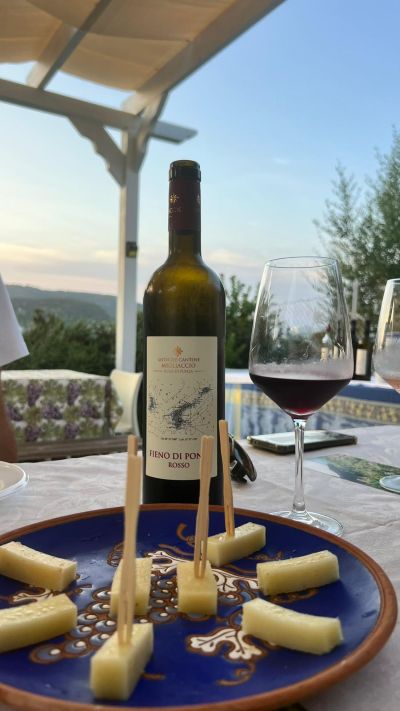
Ponza is administratively part of Lazio, in the province of Latina, but from a viticultural standpoint, it is a unique case. Together with neighboring Ventotene, it benefits from a special exemption that allows the cultivation of traditional Campania grape varieties, which are not permitted in the rest of the region. This is a consequence of the island’s history and its deep ties to Ischia and Campania.
Here, the following varieties are grown: Biancolella, Forastera, Piedirosso, and Aglianico—varieties that express a very distinct character in this environment.
The IGT Fieno di Ponza, made from Biancolella and Forastera grapes, is probably the wine that best captures the essence of this extraordinary natural amphitheater. It has depth, structure, exceptional drinkability, and a Mediterranean character that serves as the common thread throughout the winery’s entire production.
The Biancolella di Ponza, made from 100% Biancolella grapes, focuses primarily on the variety’s immediate expressiveness, while maintaining the freshness and savory notes that are among the hallmarks of the winery’s entire production.
Rosato Fieno di Ponza, made from Piedirosso grapes, is also very compelling, combining character, balance, and a decidedly original personality.
The product line also includes the Rosso Fieno di Ponza, produced in very limited quantities, which confirms the potential of this small vineyard overlooking the Mediterranean.
The Mediterranean in a Glass
 I had been familiar with the wines from Antiche Cantine Migliaccio for several years already; we had rated them very highly in previous editions of our Essential Guide to Italian Wines. Visiting the Fieno vineyards simply helped me understand even better the deep connection between those wines and the place where they are made.
Finally, there is one aspect worth highlighting. All the wines tasted are priced at about 35 euros at wine shops. Considering their quality, the necessarily limited quantities, and the objective challenges of viticulture as practiced at Fieno, the value for money is excellent.
Today, Antiche Cantine Migliaccio is a virtually one-of-a-kind enterprise on the island of Ponza. Not only because it continues to cultivate extraordinary vineyards, but also because from those vineyards it produces wines that we have, for years now, considered among the finest in Italian winemaking.