

U
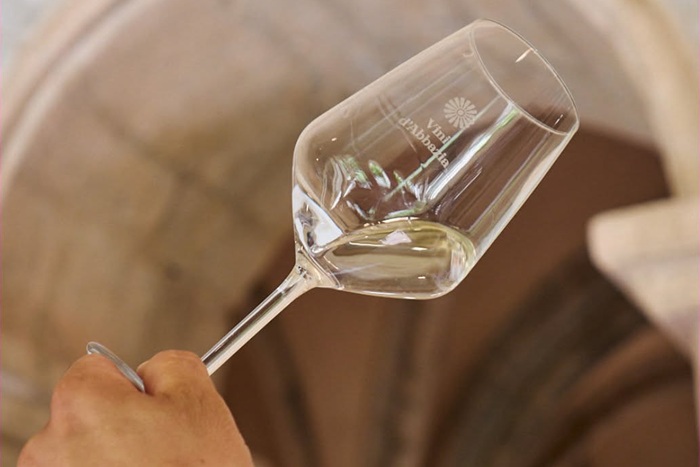
The fifth edition of the Fossanova festival, held from June 12 to 14, reaffirms the originality of a project that explores wine through the history of abbeys, the local area, and monastic culture.
Among the many events dedicated to wine, it’s rare to come across one that chooses to explore it by starting with its roots. Yet, even before it became a product, wine has been culture, agriculture, spirituality, and everyday life. For centuries, abbeys have safeguarded this heritage, contributing to land reclamation, the development of viticulture, and the transmission of knowledge that still forms part of the identity of many regions today.
This insight gave rise to Vini d’Abbazia, an event conceived by RAI journalist Rocco Tolfa, together with Francesco Zaralli and Marco De Cave. Now in its fifth edition, the festival has established its identity while maintaining its Fossanova Abbey as its natural home since its very first edition.
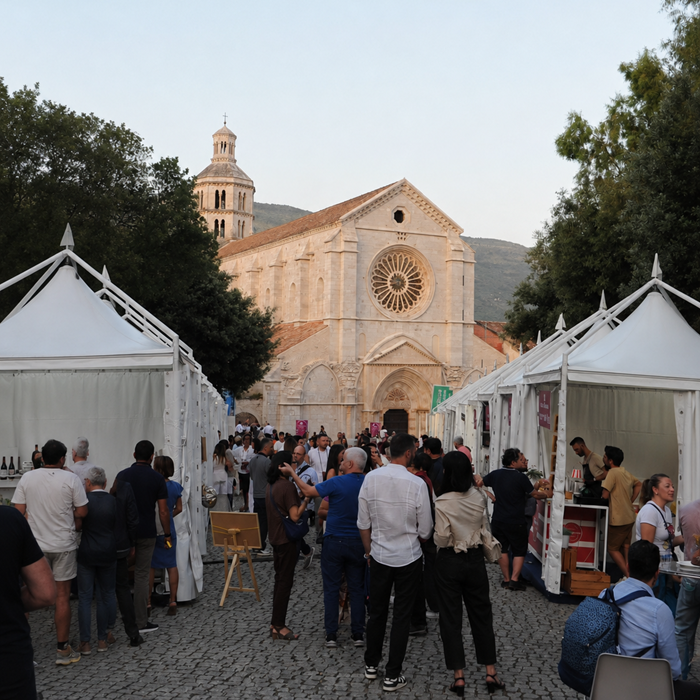
For three days, the Cistercian complex hosted producers from numerous Italian regions and some interesting international participants, along with journalists, industry professionals, and enthusiasts. Compared to the 2025 edition, in which I had participated, I noticed a significantly larger turnout. More than the numbers, however, I was struck by the way the event continues to attract people interested in learning more—even before tasting.
Not just wines produced in monasteries


Those unfamiliar with Vini d’Abbazia might imagine an event dedicated exclusively to wines produced in monasteries. In reality, the project is much more complex. Alongside the wines produced by religious communities, private wineries that cultivate vineyards on land still belonging to the abbeys also participate. A little-known aspect, yet essential to understanding the significance of the event: the relationship between the monastic world and viticulture is not merely a matter of history, but continues through collaborations that keep a centuries-old agricultural and cultural heritage alive.
Abbeys as Centers of Knowledge, Including Agricultural Knowledge
 Abbeys, after all, were not merely places of worship. For centuries, they served as centers for agricultural organization, the preservation of knowledge, and the dissemination of agronomic expertise. Many of the vineyard-dotted landscapes we know today owe a significant part of their development precisely to the work of monastic communities.
This is the central theme of the event. Wine becomes the medium through which to tell a broader story—one that encompasses the region, architecture, culture, and landscape. This is another reason why the Abbey of Fossanova is not merely a splendid setting, but an integral part of the story.
A cultural journey featuring seminars and master classes

The cultural program is one of the highlights of the festival. The seminar “Value of the Local: Between Quality and Territory” featured presentations by Enrico Chiavacci, Violante Cinelli Colombini, and Roberto Cipresso. Masterclasses addressed different but complementary themes: “The Great Reds,” led by Roberto Cipresso; “Monastery Wines,” led by Vincenzo Mercurio; and “Between Whites and Sparkling Wines: Discovering Light,” presented by Chiara Giovoni. More than just a series of tastings, it was a coherent cultural journey, in which each session added a piece to the puzzle of understanding the relationship between wine, history, and the local area.
A young and enthusiastic audience
 One of the things that struck me most was the composition of the audience. Alongside industry professionals, there were a huge number of young people—a percentage that’s truly unusual for events of this kind. They weren’t just casual onlookers: they followed the talks closely, participated in the tastings, and engaged in conversation with the producers. It’s an encouraging sign, demonstrating that wine—when presented through the lens of culture rather than just technique—can still spark interest among the younger generations.
A project that goes beyond Fossanova
In the previous months, I had also participated in the edition of Vini d’Abbazia Calabria, hosted at the Abbey of Santa Maria della Matina. It was a valuable experience that helped me understand how the project isn’t limited exclusively to Fossanova. The locations, the participants, and, of course, the wines may change, but the core idea behind the initiative remains intact: to showcase monastic heritage through viticulture and, at the same time, to tell the story of wine through the history of the territories that the abbeys helped shape.
This cultural calling was also clearly evident at the conference held in October 2025 at the Convent of the Santissima Annunciata in Franciacorta, dedicated to “Wine Culture and Territorial Identity. The Work of the Abbeys.” Rather than announcing new developments for the event, the initiative offered a reflection on the historical and contemporary role of abbeys in wine culture. Bringing together representatives from the monastic, academic, and wine-growing worlds.
The Issue of Space
If there is one area for improvement, it is the Refettorio del Chiostro, the venue for the masterclasses. The venue was consistently sold out, and during the hottest hours of the day. The air conditioning did not always prove sufficient for the number of attendees. This is an easily resolvable organizational detail that did not affect the quality of the events but could make attending a cultural program of this caliber even more enjoyable.
A formula that has become easily recognizable
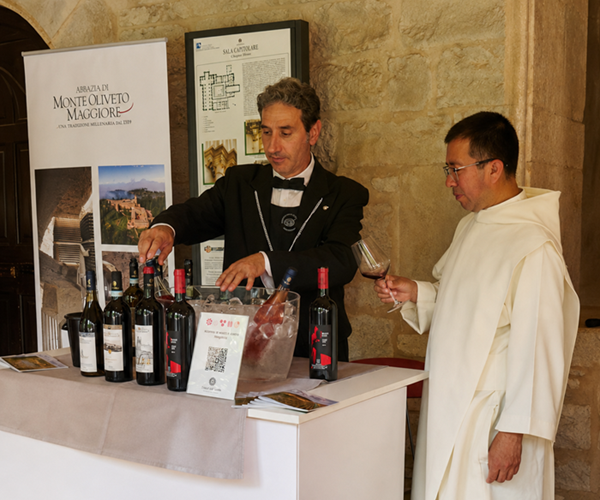
Over the years, Vini d’Abbazia has developed its own unique identity without following established models. Its distinctive feature lies not only in the quality of its wines but also in its ability to weave each wine into a narrative where history, landscape, culture, and monastic tradition coexist naturally.
Among the images I take with me from this fifth edition, there is one that speaks louder than many statistics. The consistently sold-out masterclasses and an audience made up largely of young people. At a time when the wine world is wondering how to engage with the younger generations, this is perhaps the most encouraging message left by Vini d’Abbazia.