

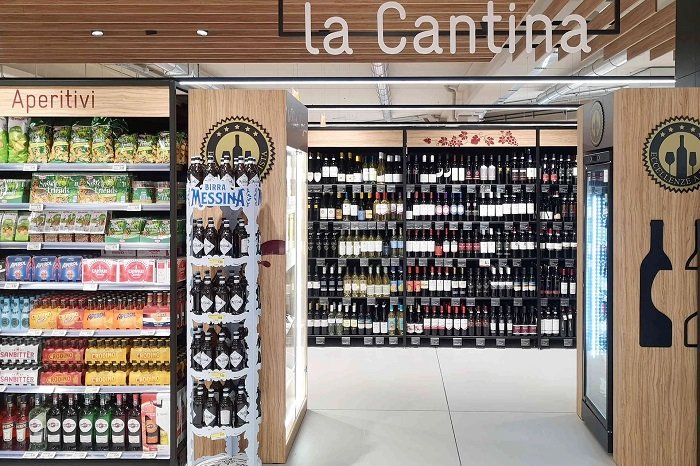

The challenge of large-scale retail with regard to wine assortments concerns the space to be given to local productions compared to those of other regions, that is, the assortments common to different stores.
Italy’s large retailers face an increasingly obvious dilemma: how much space to give to local productions versus a standardized assortment and recognizable throughout the country? Wine is the sector where this tension manifests itself most intensely. On the one hand, consumers look for products linked to their territory, and on the other they need clear and immediate points of reference.
In recent years, large-scale retailers have had to refine their strategies to find a balance between these two needs, building assortments that combine a solid common base with a targeted selection of local labels.
The common trunk: safety and recognizability
In every supermarket in Italy, from Milan to Palermo, there are references that are never lacking. Big national brands, well-established appellations, grape varieties recognizable even by those with no particular wine culture. This assortmental “common trunk” is indispensable to guarantee continuity of supply and facilitate purchasing choices.
According to Circana data, in 2024, the best-selling wines in Italian retail belong to highly recognizable categories: Prosecco, Chianti, Montepulciano d’Abruzzo and Nero d’Avola among reds, Pinot Grigio and Vermentino among whites. Familiarity with these appellations is a key factor in the choice of the average consumer, who often prefers to play it safe rather than experiment.
But this approach presents a risk. Too uniform an assortment can make the undistinguished proposal, flattening the buying experience and prompting more curious customers to look elsewhere for wines with more character and uniqueness.
Localism: authenticity and differentiation
In recent years, many large-scale retail chains have begun to enhancing the value of local wines, exploiting the link with the territory as an element of attractiveness and differentiation. The idea is simple: a customer from Turin might be more likely to buy a local Barbera than a Tuscan Sangiovese; similarly, a consumer from Puglia will be more interested in a Primitivo from its territory than a Nebbiolo.
The numbers confirm that this strategy pays off. Sales of wines with a strong territorial characterization are stable or growing slightly even in an overall declining market. According to NielsenIQ, regional labels performed better than large national brands in 2023, with significant increases in the typical geographical indication (IGT) categories.
This trend is driven by two main factors:
- Growing focus on perceived quality – The average consumer is more informed and curious than in the past. He is more likely to choose a wine that tells a story, rather than a generic shelf label.
- Support for local productions – There is a growing awareness of the local economy. Supporting small producers and enhancing local wines has become an effective selling point for many signs.
What is the right balance?
The future of wine assortment in GDO cannot be neither completely unified nor excessively fragmented. Signs must strike a balance between “common trunk” reliability and the ability to surprise with targeted local offerings.
The most effective strategies follow three principles:
- Regional customization without losing consistency
The assortment must be modulated according to local demand, but without creating excessive fragmentation. A store in Veneto must have more Soave and Amarone, but cannot give up established national appellations. - Selection based on data, not just intuition
It is not enough to include local wines to please the territory. It is essential to analyze sales data, consumption trends, and changing demand to understand which labels have real commercial potential. - Clear and engaging communication
The average retail customer is not an expert. If a local wine is not properly explained and emphasized, it risks going unsold. Clear information, eye-catching signage and effective storytelling can make all the difference.
Conclusion: localism is an advantage, if well managed
Localism is not a passing fad, but a strategic lever for large-scale retail. Those who can integrate area wines intelligently, without sacrificing clarity of offering, will have a major competitive advantage. Consumers do not want to choose between an anonymous assortment and a jungle of unfamiliar labels. He wants a balanced mix, allowing them to find both great classics and small regional discoveries. The challenge is open.


