


Wine Paris is no longer a promise. It is an established reality of world wine. The international fair held Feb. 9-11 at the Paris Expo is growing in size, credibility and strategic weight. Here wine speaks all languages and networking becomes a concrete business tool. But is everything really so perfect, especially from the Italian point of view?
Between glasses, meetings and international visions, the Parisian fair has now established itself as one of the most relevant events of the world wine calendar. But beyond the general excitement, it is interesting to wonder: Is everything really so perfect, especially from the Italian point of view?
The numbers that matter
The data speak for themselves. Wine Paris welcomed some 60,000 professionals, importers, buyers and operators, from 155 markets, confirming it as one of the most international platforms available for the wine sector today. Added to this was an outstanding exhibition presence: 6,000 exhibitors from more than 60 countries.
Here, literally, you can taste the world. The variety of offerings is wide and across the board, with wineries from every continent and a selection of labels that also includes rare and very high-profile names.
Protagonist France
France, of course, dominates the scene. But it does so with great style and effectiveness. French wineries convince by quality of organization and compactness of communication. The territories are showcased with clarity, order and strong identity: visitors immediately understand where they are and what they are tasting. A useful and replicable model of territorial reading.
Italy on the rise
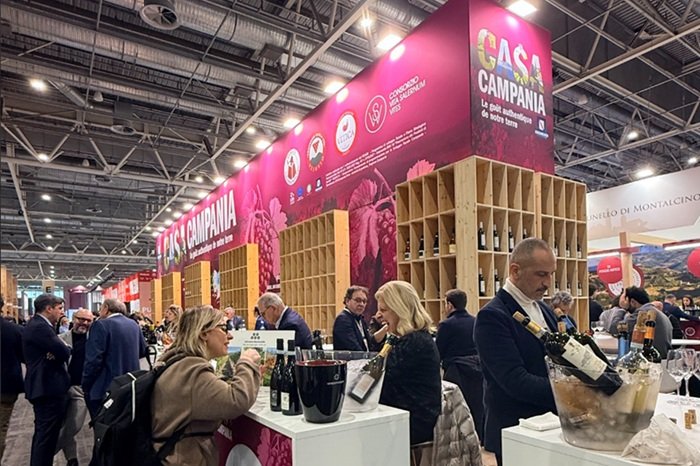
Alongside France, however, we find a very strong growth Italy showing very positive signs. This edition saw an increase of about 30 percent of Italian companies, with about 1,350 wineries present. Significant growth has resulted in a multi-pavilion distribution, with the main exhibition space strategically placed right in front of the VIP and Press entrance.
A clear signal: Italy increasingly believes in Wine Paris as an international positioning platform.
What do we like best?
Order, respect and quality of relationships is one of the most appreciable aspects. It is a fair of order and education. Little overcrowding, appointments largely met and a widespread friendly welcome. An environment that makes it possible to work with great serenity and respect, not always taken for granted at other major international fairs.
The networking is the real added value. If you come prepared, Wine Paris is a powerful accelerator of quality contacts. Less frills, less worldliness for its own sake, more concrete, business-oriented conversations. It is a fair that rewards those with clear goals and a well-defined strategy.
A privileged observatory
It is also a privileged observatory on emerging trends of the industry. Wine Paris is not just a trade show. It is a very clear snapshot of where wine is going. The event looks at the market even before the product, and this is making a difference today. Not surprisingly, great attention has been paid to complementary and alternative sectors, such as No-Low Alcohol e Spirits, which are very popular, as well as cross-supply chain solutions and services.
And of course Paris is still Paris
The City. Let’s not pretend that Paris itself does not have great appeal, which makes it all the more enjoyable. But it does not only attract for its charm and countless artistic beauties, but also for the benefits that include ease of travel and organization. It is a city that absorbs without blow, all the attendance flocked to the event.
Critical issues for improvement
Even here, however, some limitations emerge: we see some critical issues that could be improved.
The fair is very large and scattered. Without careful planning, you risk walking for hours and taking little home. Indoor signage does not always help: without a prior study of the map, some pavilions can turn into a real labyrinth.
Some spaces appear cramped or arranged, such as Hall 2.1, which also experienced temperature problems on the first day, bringing no small amount of inconvenience to exhibitors and visitors. A side effect of the event’s very rapid growth, which saw demand for participation explode.
Italy is not so stormed, many visitors to Wine Paris prefer France’s busy, Spirits, far-flung areas or wineries that are normally difficult to find. It bodes well, however, that this same audience leaves it aside knowing that they attend the ever-present Vinitaly just over a month later.
Less emotion, more pragmatism
Those looking for storytelling, poetry and immersive experience may be partially disappointed. Wine Paris is a technical fair, concrete with less entertainment, fewer special effects and more substance.
A plus or a minus? It depends on what one is looking for.
Fundamental: This is not a fair for improvisation.
Without appointments set in advance, you risk being subjected to it, not driven by it. As a visitor you can be bounced around like a ping pong ball; as an exhibitor, on the other hand, you can be left waiting for nothing.
More than a fair of advancement, it is a consolidation fair, where everything has to be planned upstream to avoid blowing a hole in the water. It is an approach that, after all, reflects an increasingly common trend in the international exhibition scene.
Wine Paris is not the dream fair. È the strategy fair. And those who approach it methodically come out stronger.
PHOTO GALLERY.

