

A story of passion, naiveté and redemption: the pursuit of a mythical Brunello that ended up in a braise and was found again 20 years later, to discover what great wine really means.
In early 1978 I was new to wine. I was frequenting some Roman wine shops – Buccone Via di Ripetta, Costantini in Piazza Cavour, Quadrozzi on Via Ostiense-not only because of the selection, but also because they were easily accessible by transportation. So I could go home loaded with bottles without too much effort.
I was 23 years old, with little money and a growing passion. I was buying wines for a thousand lira: Merlot and Cabernet from Bossi Fedrigotti, Barbera d’Alba OdderoChianti Classico Savignola Paolina ’76, difficult vintage and low price. Already costs were going up with the Red Col d’Orcia and Barolo ’71 from the Barale Brothers, the first one I drank.
Obsession with a bottle
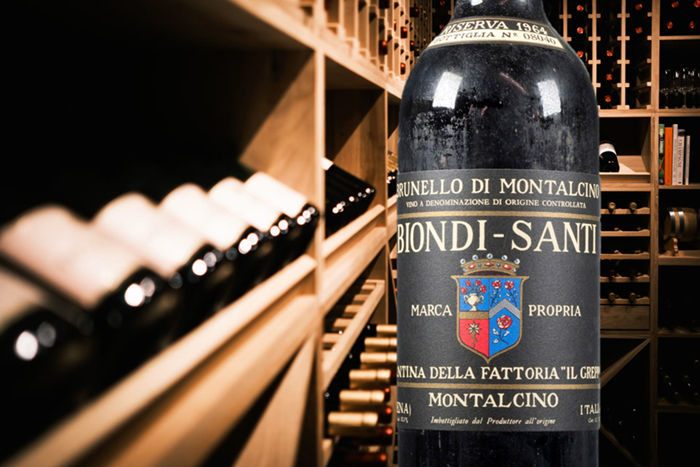
But for months I had been eyeing a different, very expensive bottle. A myth, celebrated by Veronelli and the experts of the time: Brunello di Montalcino Riserva ’64 by Biondi Santi. It cost a whopping 105,000 liras. Crazy: the equivalent of hundreds of liters of gasoline, or a thousand streetcar tickets.
Those were complicated years, amid recent austerity and social tensions. But passion is passion. Irrational, totalizing. And I, who was already writing to Veronelli considering him a master, an ideal reference point, almost like Weber, Croce or Marx, felt no reason.
The stroke of genius to buy it
To buy it I invented a job. My parents had a furniture store, and I convinced some dealers to promote a line of modular bookcases with a leafleting in Roman parking lots.
For two weeks with a group of friends we distributed over a hundred thousand leaflets. A 3 lira per flyer. I, who had organized everything, held back a little more. It wasn’t exactly ethical, but I had a goal.
The dream finally realized
When I had the money in my hand I entered Quadrozzi’s triumphantly and said proudly:
- “I would like the Brunello di Montalcino Riserva ’64 from Biondi Santi“.
- “But do you know how much it costs?” the clerk replied in amazement, calling me “tu.”
- “I know, I know, don’t worry.”
He carefully took the bottle, dusted it off, wrapped it, and placed it in an elegant black cardboard tube with the wine label printed on it. It had been there for years, unsold. Not surprising at that price.
I took her home and carefully laid her down in the dark.
The dream that ends up in the kitchen
I was still living with my parents, and I could not imagine what would happen just a couple of days later. The following Sunday my mother had guests.
He presented a sumptuous braised beef in red wine at the table and candidly told me, “I used that old wine you had brought home. I thought by now it could only be used for cooking. You know it was still good, though? I drank the last glass while cooking “.
 Twenty years later, the rematch
It took me 20 years to finally drink a bottle.
It happened in Montalcino, at the home of Franco Biondi Santi. I told him the story and, perhaps pitilessly, he gave me a bottle of that reserve as a gift after opening one at lunch.
I drank that bottle only some time ago, by which time its value had risen to thousands.
But I had it, and I opened it ..
It goes down into the glass
The cork, replaced in 1997, pulls out without difficulty. I open a few hours in advance, not the day before as Franco Biondi Santi suggested, exaggerating a bit, in my opinion. Perfect cork, only a little bit of tartrates that almost made the part that was in contact with the wine glisten.
I don’t carafe it, I serve it in medium sized glasses, the one for Sangiovese, with great care. The finish is a tiny bit veiled, but I remember Franco Biondi Santi wanted that for himself. “That’s the best part, there’s all the substance of the wine,” he used to say.
Brunello del Greppo
The magic of great wines begins when they slowly descend into the glass and you can smell the fragrance in the air. Black cherry in spirit, tobacco, perhaps raspberry, then goudron, smoky notes. Spectacle. So is the color. Slightly veiled, it’s true, but a vivid, bright garnet, certainly not concentrated, with the nail between old rose and orange.
I smell the scents again. In the glass they are sharper and more precise, but they trace the earlier sensations. Perhaps there is some dried violet notes, and some barely balsamic hints. Not as in the ’75 Reserve, though.
Taste. Immediately I am struck by a component of composed but fresh acidity, very evident, from a much younger wine. It almost makes one salivate, and accompanies the gustatory silhouette all the way through. Some tannic hints, but in the background, and a subtle, very elegant, agile and very long persistence.
When a wine exceeds the grape variety
Some would say it is a sketch of a great Sangiovese, but no.
It is not Sangiovese, it is Brunello del Greppo.
Just as La Tache is not Pinot Noir, it is La Tache, different from Romanée Conti, different from Richebourg. At this level definitions cannot be generic.
Picasso is not “a cubist.”
Of course, it is “also” Sangiovese, and at the time maybe there was a little bit of Canaiolo. Now it can’t be done, and at Greppo they were forced to level out about 20 half-century-old Canaiolo and Colorino vines-which in the fall, because of their red leaves and not yellow like Sangiovese, “wrote” BS in the vineyard-because keeping them would have been contrary to the production specification. But let’s leave it at that.
Time in the glass
Back to the wine, which slowly evolves in the glass, as only the very great ones can do. Black tobacco, some mineral notes, greater softness. The acidity integrates, refines.
In the end, the feeling is that the wine ends too soon.
And the second bottle is not there, dammit.
One hundred and one cents. You can, you can.

