

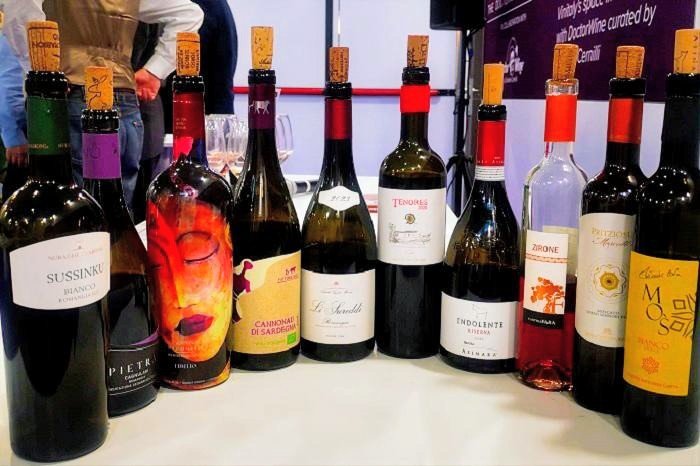

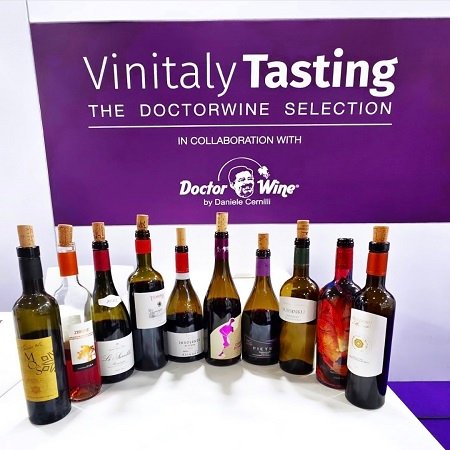
The masterclass organized by the Terre di Romangia Consortium at Vinitaly Tasting – The DoctorWine Selection and led by Daniele Cernilli, analyzed territory, grape varieties and style through ten wines. Focus on wind, Cannonau and varietal recovery.
Romangia was the protagonist at Vinitaly 2026 with a masterclass organized by the Terre di Romangia Consortium as part of “Vinitaly Tasting – The DoctorWine Selection.” It was conducted by Daniele Cernilli, who proposed a critical reading of the territory through a selection of ten representative wines.
The initiative, carried out with the support of the municipalities of Sorso and Sennori and included in the DoctorWine seminar program at Veronafiere’s Hall 10, offered operators an in-depth analysis of grape varieties, styles and production identity of one of Sardinia’s largest areas, with about 1,200 hectares under vine.
The role of wind in defining style
 At the center of the talk is the decisive role of wind. According to Cernilli, flows through the Bocche di Bonifacio generate a cooling effect that promotes more pronounced temperature excursions, contributing to the production of more elegant wines with greater aromatic integrity and less oxidation. The Mistral also facilitates drying on the vine, a widespread practice among local producers.
Romangia’s Cannonau and identity grape varieties.
Stylistically, the Cannonau of Romangia has been described as “very Grenache,” close to the models of the Rhone and Châteauneuf-du-Pape: Mediterranean, warm and enveloping, distinct from the more austere mountain Cannonau. Alongside this grape variety, there is also room for Cagnulari – present only between Usini and Romangia -, Vermentino and Moscato di Sorso.
The recovery of native grape varieties
 Part of the tasting was devoted to varietal recovery. Among the cases highlighted were Zirone relaunched by Giorgio Fara and Retagliadu Nieddu, an ancient biotype of Cannonau brought back to attention by Tenute Dettori in collaboration with nurseryman Marco Moroni since the early 2000s, now cultivated by a growing number of companies, among the first the Antichi Vigneti Manca.
Two Moscati of Sorso compared
Closing dedicated to Moscato di Sorso with a comparison of two distant vintages: Nuraghe Crabioni‘s Pretziosu 2023 , characterized by balsamic notes and good executive cleanliness, and Antonio Carta’s Moscato di Sorso 2005, defined by Cernilli as “a sort of outlier,” with evolved profiles of licorice, dried fruit and hints of the great Mediterranean fortified wines.
Two interpretations distant in time, but traceable to the same territory. A testimony to the temporal depth of a winemaking tradition that Romangia continues to cultivate.
The invitation to Romangia
At the end of the masterclass, the Terre di Romangia Consortium, with the support of the Vice Mayor of the Municipality of Sorso Federico Basciu and the Councillor of the Municipality of Sennori Elena Cornalis, invited Daniele Cernilli to visit the area for a summer event. Invitation accepted, with the aim of deepening in the field the work initiated in Verona.
The companies in the tasting
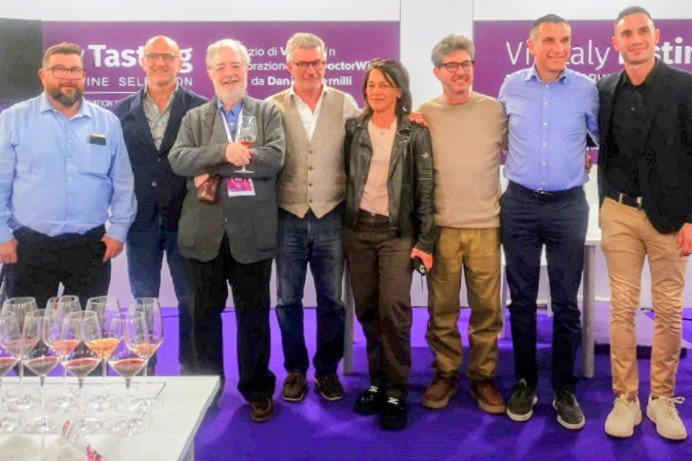
The selection of ten wines represented the plurality of the area, involving historic cooperatives, family businesses and new generation producers.
- Nuraghe Crabioni (Sussinku 2023 and Moscato Pretziosu)
- Romangia Winemakers (Cagnulari Pietra 2024)
- Sorso Sennori Winery (Isola dei Nuraghi Carignano 2023)
- Island Farm (Cannonau of Sardinia 2024)
- Antichi Vigneti Manca (Romangia Rosso Li Sureddi 2023)
- Dettori Estates (Romangia Rosso Tenores 2020)
- Asinara Estate Roberto Sassu (Cannonau Riserva Indolente 2020)
- Fara Winery (Zirone 2024)
- Antonio Carta (Moscato di Sorso 2005)

