


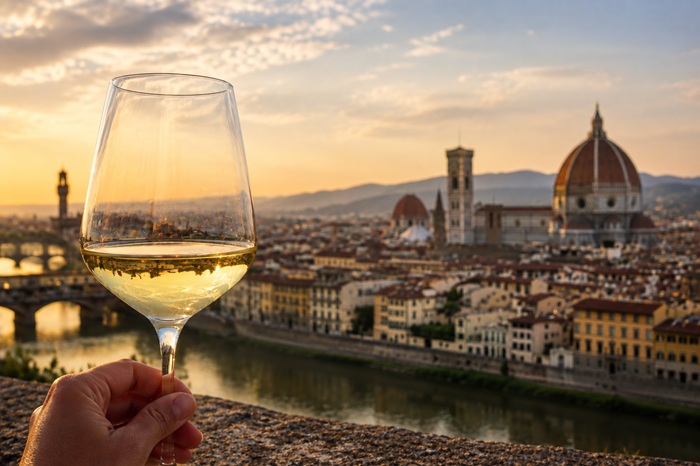

For decades, Tuscany has been identified almost exclusively with great red wines. Today, however, the growing demand for white wines with character and a new project promoted by the Consorzio Vino Toscana and the University of Pisa are reigniting a question that has remained unanswered for far too long: Is it time to create the great white wine of central Tuscany? Stefania Vinciguerra tells us more.
Some ideas come too soon, while others simply wait for the right moment. Perhaps the project Bianco Toscana belongs to the second category.
The initiative, which was launched in part thanks to the effortsof the Associazione Le Donne del Vino della Toscana and is now being developed by the Consorzio Vino Toscana in collaboration withthe University of Pisa and CREA in Arezzo, is not intended to create a new wine on paper. The goal is to understand which grape varieties, which agricultural practices, and which winemaking techniques can lead to the creation of a great white wine capable of representing central Tuscany.
That’s a significant difference. Because here, we don’t start with a set of specifications, but with research.
Tuscany isn’t just red
For years, the international success of Chianti Classico, Brunello di Montalcino, Bolgheri, and Nobile di Montepulciano has inevitably overshadowed everything else—even the white wines.
And yet Tuscany possesses a wealth of terroirs which few European regions can boast: high altitudes, soils composed of galestro, alberese, sandstone, and clay, cool exposures, and significant daily temperature fluctuations. These conditions allow for the production of white wines of remarkable elegance.
There are, of course, already examples of Tuscan white wines. Vernaccia di San Gimignano—rightly excluded from the project—represents a historic and well-established appellation. In recent years, Vermentino has come to the fore along the coast, and there are also various estate-bottled whites, some of which have been successful. However, there is no widely recognized benchmark.
Not the Same Wine for Everyone
But the project does not seek a one-size-fits-all solution. The researchers will analyze existing vineyards, monitor production according to agreed-upon protocols, and compare the results to identify the more effective solutions. Wineries will make their vineyards and cellars available without incurring additional costs, while the knowledge gained through research will be shared with all producers.
It is a scientific approach, but one that is deeply rooted in agriculture. First, you observe the area; then, if necessary, you develop a vision.
The time is ripe to launch such a project. After all, the market is calling for it. Consumers are looking for white wines with character, wines that pair well with food, and wines capable of aging over time. This is exactly what Tuscany has to offer. It’s no coincidence that more and more wineries are investing in this category.
A bet worth keeping an eye on
Of course, a research project alone isn’t enough to create an icon. It will take years of experimentation, discussion, and testing. It will take companies’ willingness to take a critical look at themselves. And we’ll need to resist the temptation to follow existing models.
If the great Tuscan white wine is ever to come into being, it must speak with a Tuscan accent. It must not imitate Burgundy, South Tyrol, or Friuli. It must tell the story of the Chianti hills, the lands around Siena, and the region’s inland areas in its own voice. And that is precisely the most fascinating challenge.
Tuscany doesn’t need to prove that it can produce great wines. It has already done so.
However, it can demonstrate that it knows how to write a new chapter in its winemaking history. A chapter that has so far remained in the background, almost overshadowed by the Reds’ impressive success.
If research can transform insights into knowledge and knowledge into wines, then the question we’ve been asking ourselves might finally be answered. Perhaps so. Tuscany might truly have its own great white wine. And that would be good news not only for Tuscany, but for Italian wine as a whole.


1 comment
Perhaps they should consider grafting some trebbiano Abruzzese ?