


Last July, the interesting food and wine festival “In the Lands of Grechetto” 22nd edition was held in Civitella d’Agliano: July 25, 26 and 27, 2025.
The beautiful country where the si sounds is also the Country of Autochthonous Grapes, having more than 500 among those officially registered in the National Register of Vine Varieties. Actually there are even more, but some are in the process of being registered or just unknown to us. I will tell you about them in one of my next articles, it is a topic I am very passionate about.
The Grechetto, precisely, is one of Italy’s native grape varieties, widespread between Latium and Umbria, where, alone or in blends, it enters various appellations. We also find it in Emilia Romagna where it enters the Colli Bolognesi Classico Pignoletto DOCG, in the Grechetto Gentile clone (which in the area is called precisely Pignoletto).
In Civitella d’Agliano, in the province of Viterbo, they have been organizing a food and wine festival dedicated to him. I attended the last edition, tasting about sixty of them blind and then randomly re-tasting them, accompanying the food. But before we delve into more technical details, it is only fair that I spend more than a few words publicizing and giving credit to this beautiful manifestation. It involves the whole town, whose historic center has less than 50 inhabitants, which sees several wine-tasting corners scattered among the beautiful alleys, the main square with live music and a large area where you can taste delicious local cuisine. All, of course, coordinated by the Municipal Administration, the Pro Loco and Carlo Zucchetti.


Back to the wines
Grechetto gives rise to wines that are very different from each other, depending on where they are grown, and in the Tuscia viterbese there is also an important contribution of volcanic soils. In addition, net of the different soils, there are the individual wine styles And so the deal gets complicated. One thing is certain: usually wines from Grechetto do not have in the aromas their strong point. However, among the many wines tasted, some samples presented a markedly more expressive olfactory imprint than all the others, the result of a quite different oenological technique. These techniques, which some producers choose to pursue by proposing a wine with different characteristics from the traditional ones, are to be practiced with special care and attention, because they risk confusing the drinker. At the current state of shared knowledge, in fact, they seem to ape wines that have little to do with the territory to which they belong, causing the entire appellation to lose its distinctive characteristics. (But we at DoctorWine think the path of research and experimentation is the right one, so we welcome in-depth studies on this, ed.)
While there is still a lot to be done on the aromas, quite different is the issue of the sapidity, on the persistence and on the longevity. As we will never tire of repeating, the time for white wine to be drunk within the year following the harvest is long gone. The list of wines and appellations capable of project oneself in time is now very long. Grechetto fits right into this list. Of course, not indiscriminately all wines, but those made cum grano salis, by the most prudent and scholarly producers.
Longevity, a winning weapon
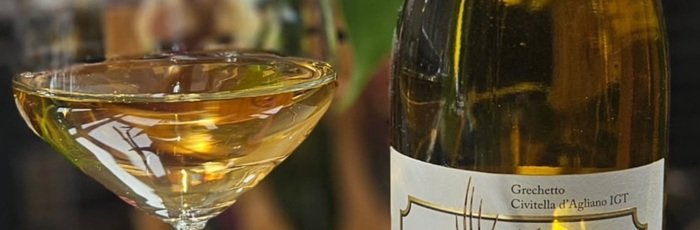
In fact, among the sixty or so wines tasted blind, those that impressed us most positively were those not a few that had more years on their shoulders, even several. I am not revealing anything secret if I tell you that in this ranking the wines of Mottura play a league of their own, but other producers, both from Umbria and Lazio, are perfect seconds.
In addition, savoriness, freshness, combined with low alcohol content, make the various Grechettos enviable meal companions. Which wines? Well, we just presented our Essential Guide to the Wines of Italy 2026 in Milan, where you will find what we think are the best Grechetto-based wines, and if you are curious, come to the presentation in Rome (Oct. 11), you are still in time.
I conclude by formalizing my surprise with respect to some Pignolettos from Emilia-Romagna, previously unknown to me, which, thanks to their own fruit brightness, have climbed my personal ranking. I definitely need to delve deeper…it really is true that you never stop learning.