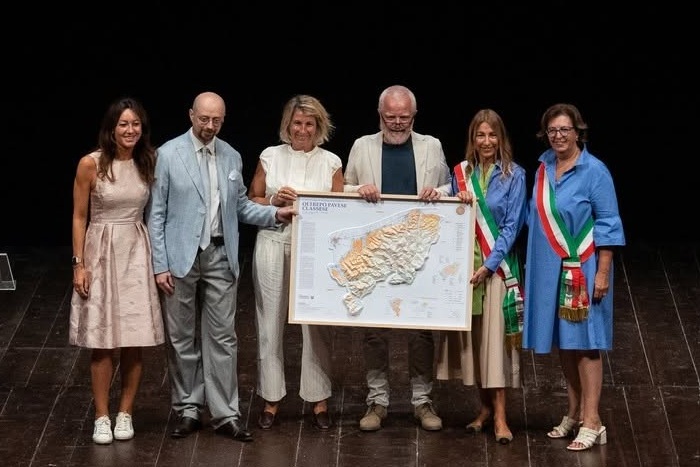
Unveiled in Voghera during OltreGusto, Alessandro Masnaghetti’s map interprets the Oltrepò Pavese region through its valleys, vineyards, and place names. It serves as a tool for understanding and highlighting the region’s distinct characteristics, supporting the revival of the Classese appellation and the Consortium’s efforts to raise the profile of these wines and enhance the value of their origins.
First and foremost, there is a choice behind the map by Alessandro Masnaghetti presented on September 7 at the Valentino Garavani Theater in Voghera, as part of OltreGusto. That of theOltrepò Pavese, which, through its Consortium, has decided to start by understanding its own geography in order to develop a strategy for promoting the region.
Not a destination, but a starting point. First we map it, then we tell its story, then we showcase it. At the heart of this journey is the Pinot Noir, the region’s signature grape variety, along with the Classese. The historic name revived to distinguish the Metodo Classico sparkling wines produced in these hills.
A Map for Understanding the Area
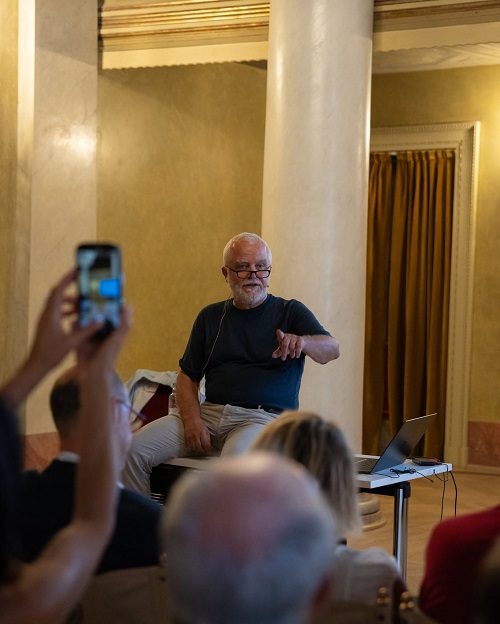
It was Masnaghetti himself who, at a press conference, highlighted a key point. His is not a zoning study in the technical sense, that classifies the land according to agronomic or oenological parameters. The map weaves together geography, history, and local traditions, with geological and viticultural references. Providing the Oltrepò with a comprehensive overview that had been lacking until now. A map, therefore, conceived more as a narrative tool than as a scientific endeavor, capable of bring order to a historically fragmented territory without, however, flattening its differences. Accompanied by a handbook and a three-dimensional version, it helps users navigate a complex territory.
And there are truly many differences in the Oltrepò region. Masnaghetti said that he had never encountered such an abundance of place names. A linguistic and geographical heritage that, until now, had remained largely an oral tradition, known to those who live on and work the land, but difficult to convey to outsiders. The map gives visible form to this vocabulary of places which wineries can use to accurately describe where the wine poured into a glass comes from.
Four Valleys and Pinot Noir
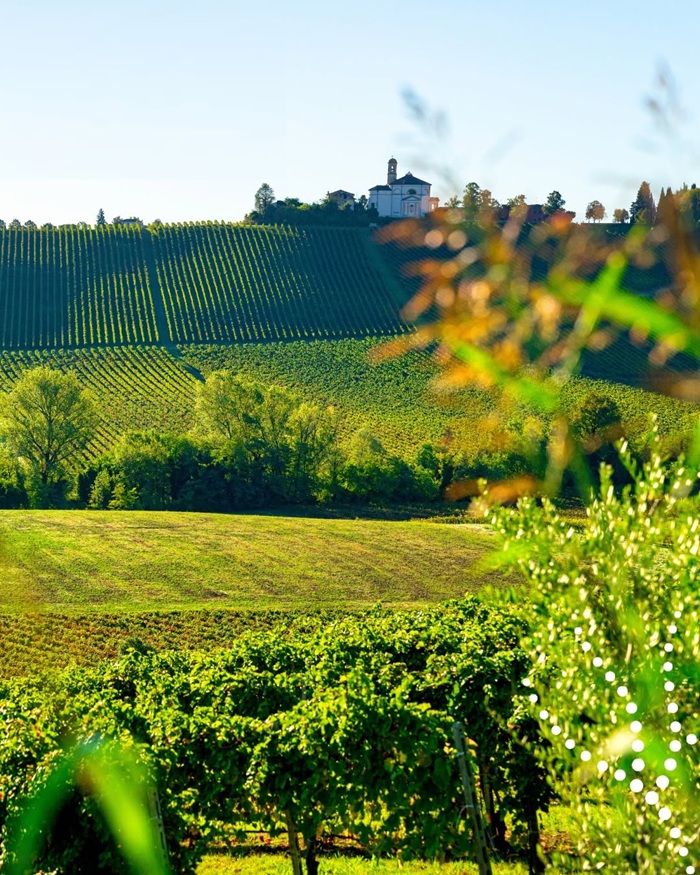
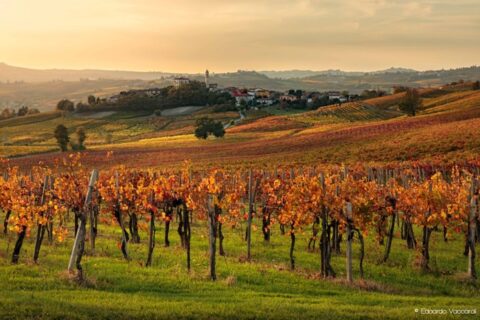
The region lends itself to this complexity. Oltrepò Pavese stretches along four main valleys. The Versa, Scuropasso, Coppa, and Staffora. A border region less than fifty kilometers from Milan, nestled between Piedmont, Emilia-Romagna, and the Ligurian Apennines. The vineyards climb to altitudes ranging from 120 to 550 meters. With a variety of exposures, slopes, and soils that vary from one valley to another. Today, thanks to the map, these features become clear even to those who haven’t known the area their whole lives.
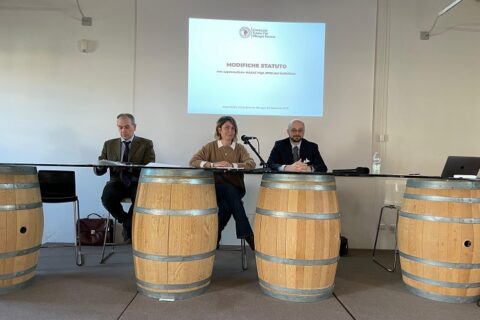
It is no coincidence that these four valleys in particular have become key geographical references in the project to revise the regulations for the Metodo Classico DOCG. The goal is to make clear the connection to the grapes’ origin. Focusing on the individual terroirs and the characteristics that make their way into the bottle. With particular attention to blanc de noirs and rosé de noirs, aging times, and, more generally, a winemaking style centered on Pinot Noir. With nearly 2,900 hectares under cultivation, more than a quarter of the DOC and DOCG region’s vineyard area as its cornerstone. The debut of the first bottles under the the Classese brand, which took place at Vinitaly 2026, marked the first concrete step in this communication strategy, without, however, superseding the Oltrepò Pavese Metodo Classico DOCG designation.
A Shared Story
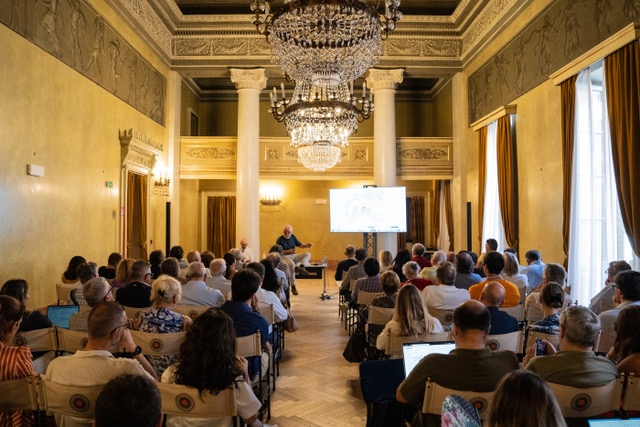
As Riccardo Binda, director of the Consorzio Tutela Vini Oltrepò Pavese, pointed out, this is a project that the region and its producers have long awaited. A tool to describe the Oltrepò through its valleys and overcome the fragmentation that has long weakened its image and the not always balanced relationship between the quantity produced. And the value attributed to each bottle. A new charter, greater representation of small producers, a revision of the production regulations. The return of the Classese designation, coordinated communication, and now Masnaghetti’s map are all pieces of a single plan. To restore to the Oltrepò the pride and value it deserves.
For enthusiasts, sommeliers, and industry professionals, Masnaghetti’s maps have the charm of a sticker album we used to flip through as children, trading duplicates while shouting. “I’ve got it, I’ve got it—you’re missing one!”. There’s the same anticipation, the same desire to complete the picture, to discover a new name and recognize it on the map. With this map, the Oltrepò region can look at its own album and say, with pride. “I’ve got it!”
OTHER ARTICLES