Italian wine returns to the center of the institutional narrative with a campaign that reaffirms its cultural, identity and social value, going beyond the product dimension. From February 15, Vigneto Italia, the promotion project presented at the Ministry of Agriculture in the presence of the entire wine industry and guided by the claim “Let’s cultivate what unites us,” kicks off. Here is Antonella Amodio ‘s interview with Piero Mastroberardino.
The campaign, illustrated by Minister of Agriculture, Food Sovereignty and Forestry Francesco Lollobrigida, consists of two commercials. One institutional and one emotional. It will run through mid-March in the main national media. This will be followed by a new installment accompanying Italian wine to Vinitaly, flanked by a social campaign aimed particularly at the younger generation as well.
At the center, wine as a cultural heritage and a tool for responsibility, to promote a culture of conscious consumption.
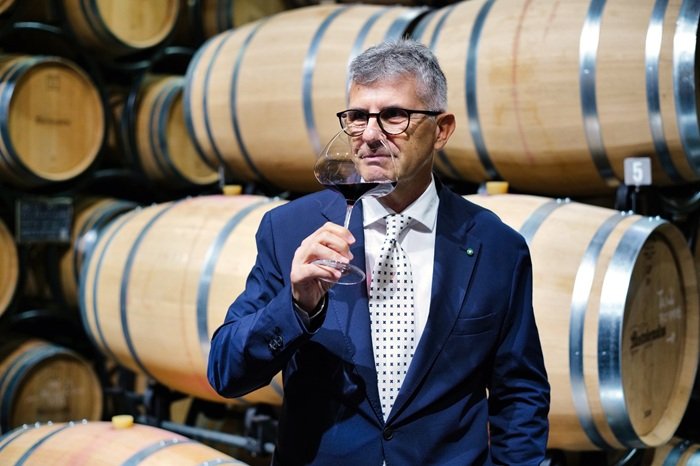
On these issues we interviewed Cavaliere del Lavoro Prof. Piero Mastroberardino, vice president of Federvini, among the most authoritative voices on the Italian wine scene and a profound interpreter of the link between the vineyard, history and the future.
A million-euro campaign: why it’s a turning point
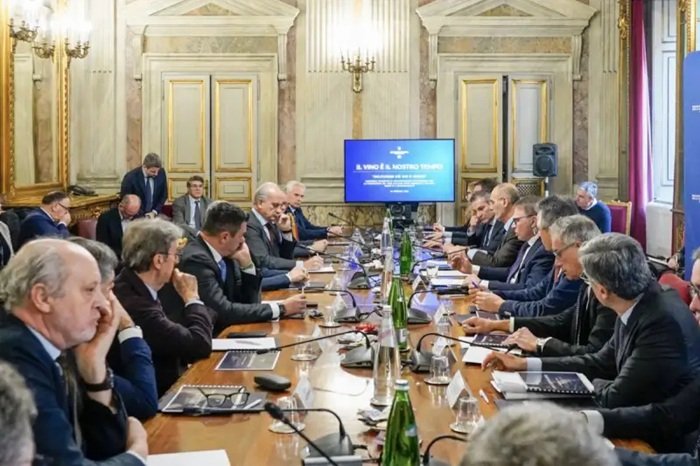
The institutional communication campaign launches on February 15. What is its significance and what does this 1 million euro funding entail, in light of the fact that you called the meeting at Masaf “a turning point”?
To have obtained a major resource allocation from the government, purely dedicated to wine, is undoubtedly a major achievement that few would have bet on. When I made the request, in the capacity of coordinator of the National Supply Chain Table, I addressed the Prime Minister and the three ministers responsible for the issue, Agriculture, Business and Health.
The intent was precisely to stimulate a well-rounded reflection on the issues of the wine culture and its values. Involving the different sensitivities involved. We immediately got positive feedback, and so the meeting at Palazzo Chigi on August 4 was held. From there began a discussion that required no small amount of effort on both sides.
We made proposals on the target audience and message content. Which the Masaf structure worked on in a way that took into account a number of constraints that also condition the communication processes of our products, until the day of February 2, when we were presented with a detailed program and an initial campaign launch spot.
Beyond the product: putting wine culture back at the center
Why is it so important today to put wine culture back at the center, going beyond product and consumption?
Because we have taken too many things for granted. Because we thought that the deep innervation of wine culture in our sociocultural system would all in all withstand the repeated, violent, ingenerous attacks that our industry has suffered for decades. Our cousins across the Alps have on this front an overly renunciatory and rearguard attitude that risks jeopardizing a supply chain that is a symbol of Mediterranean lifestyles, a true bulwark of quality of life, healthy eating habits and more.
Economy, work and territory: a message to be renewed
Vine and wine are also economics, labor, and land stewardship. How much does this value weigh in the public narrative of wine today?
These themes, too, have been revived so many times that their full meaning and value has not been grasped by now. Repeated use of a concept paradoxically risks weakening it, making it fall into a kind of background noise in which it is confused with the plethora of clichés and redundant messages. That is why it is necessary to break out of that indistinct mass and clearly reaffirm, even with the courage of new languages, different terminology and a renewed evocative atmosphere, all that is positive about this world.
Sustainability, landscape and joy of living
Protection of the environment and the wine-growing landscape is one of the central themes. How does the campaign address the issue of sustainability?
The campaign takes its start from these themes, shows how the roots of this world are intimately linked to the culture of landscape. To order, to beauty, to the integrity of hilly rural areas, to a concept of sustainability that results in the sharing of an emotion, of being well together, of the joie de vivre.
These are the sensations that those who love wine naturally and commonly experience. After this first commercial, a second one will be made, which should, according to plans, aim more to reinforce this second part of the message.
Responsible conviviality: an authentic message
The concept of responsible conviviality is often misunderstood. What message does this campaign intend to convey?
The message is one of spontaneity, truth, not a courtly or exclusive context, not a place of scholarly extremism without which you remain cut off. Not a space reserved for initiates ready to duel over the origin and composition of soils or chemical and physical parameters.
Rather, a sphere in which everyone feels comfortable expressing his or her feelings, without being forced to do so, as wine naturally accompanies the moments of our existence.
Culture and responsibility in consumption
How can one defend the cultural value of wine without denying the issue of responsibility in consumption?
With a responsible approach, with an essential level of tasting education. That induces one to linger long on the nose of the wine and sip in moderation in order to enjoy the taste of the different characters that each wine expresses, with the rejection of abuse, with typical wine gestures, until naturally acquiring the measured and fine way of handling a glass. Without heaviness, but with respect and a sense of responsibility.
Wine as a symbol of the Italian lifestyle in the world
Wine is one of the strongest symbols of the Italian lifestyle in the world. How is its narrative changing today on an international level?
Much of the communication activities are still focused on the elements of technical knowledge of the product and its origin, since, after all, there is an audience of wine lovers who attend master classes, seminars, and tasting events, which still require this approach.
The point is what happens around and beyond this circle of aficionados. It is there that the search for language, codes, symbols requires open-mindedness. Willingness to experiment, to break some patterns, even a good dose of courage. It is there that the game of the overall breadth of the wine consumption pie is played and not the knife-in-the-teeth battle to enlarge one’s individual slice.
Youth, consumption and the future of the supply chain
Who is this campaign primarily aimed at: producers, consumers, institutions, or new generations?
The target audience is mainly that of young people aged 25 and over, urban, social, curious, lovers of travel, atmospheric clubs, and dinners at home among friends. The key point is to stem as far as possible the phenomenon of erosion of domestic consumption. Since Italy, as a great producing country, cannot give up the hard core of its cultural context of origin. In order to be also more credible in the proposal towards the publics of emerging countries and new consumers.
Communication languages and tools
What kind of language and communication tools were chosen to make the message effective and contemporary?
The campaign is divided into a section for the domestic market and one for international markets. The former is based on the communication activities we have discussed so far, with the target audience outlined above, and uses passages of 30″ commercials across widely circulated media, TV, print, web, as well as a section developed specifically for social media.
International part, entrusted to ICE programming, will have development and coverage of different markets, but we have not yet gone into the details of the analysis.
A long-term cultural investment
What is the result you hope this campaign will leave in the medium to long term?
My first and greatest wish, which moreover is a plea that I have personally made to our governments since my first experiences in wine lobbying. Dating back to the 1990s of the last century, is that such an institutional communication campaign becomes a constant in the planning and allocation of public resources. Our country cannot fail to have a stable and continuous institutional investment in such an important asset of its trade balance.
I hope that this campaign will help recreate around wine and its world a climate of truth and positivity. Which the wine world has shown it deserves. And that a new future can be built on this first important result for the industry and those who truly believe in it, in a non-speculative way, having respect for the values it embodies and passes on.
The key message
If you had to sum up the key message of the campaign in one sentence, what would it be?
Here rather than invent, I prefer to defer to the claim proposed by the Masaf team, which sounds like this: “Wine is our time. We cultivate what unites us.”