

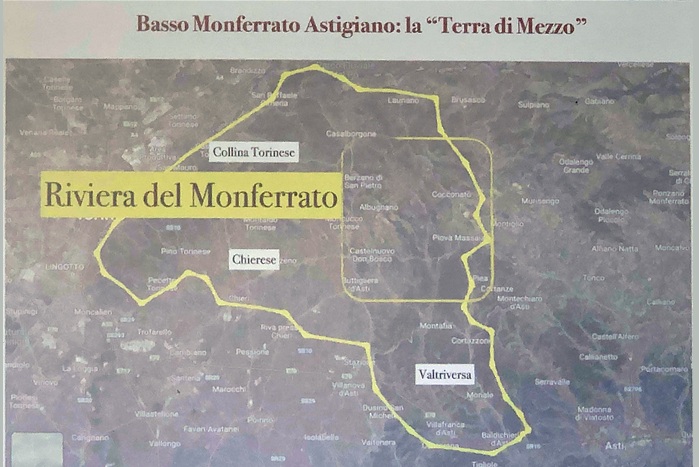
Between Albugnano and Cocconato, the Monferrato Riviera brings together the villages, vineyards, and traditions of northern Asti. A landscape shaped by the ancient sea, where Barbera, Freisa, and Malvasia grow alongside Nebbiolo. The Albugnano 549 project promotes Nebbiolo through the collaborative efforts of local producers, while the region also showcases itself as a destination for food and wine tourism. Luciano Pavesio tells us more.
The Monferrato is not merely a geographical concept, but a historical and social entity that has taken shape over the centuries around its distinctive horseshoe-shaped outline. Defined by the feudal marches of the Middle Ages. In this land, historically tied more to the identity of its communities than to any single major city, lies the famous legend of Marquis Aleramo and his ride.
Today, a regional and winemaking project breathes new life into this story. “Stop looking for the horizon. You’ve just arrived in a sea of hills” is the official slogan of the Riviera del Monferrato tourism brand. The project is promoted by the Enoteca Regionale di Albugnano led by the President Davide Gasperini. Together with Winemaker Giampiero Gerbi. The Cocconato Riviera del Monferrato Consortium represented by Luigi Dezzani, and the mayors of the 11 municipalities involved. (Albugnano, Moransengo-Tonengo, Aramengo, Castelnuovo Don Bosco, Moncucco Torinese, Passerano Marmorito, Robella, Cerreto d’Asti, Cocconato, Pino d’Asti, and Buttigliera d’Asti).
Traces of the ancient sea


The definition “Riviera” is not merely a poetic flourish. But refers to the geological origin of the area. Millions of years ago, these lands were covered by the sea. Mineral-rich sediments deposited on the seabed as glaciers gradually melted, along with subsequent geological transformations helped shape the landscape and soils that today are home to the vineyards. Thus, the first “Terre Emerse” (Emerged Lands) came into being, including the Torinese Hills, stretching from Turin to the borders of what is now the Oltrepò Pavese region.
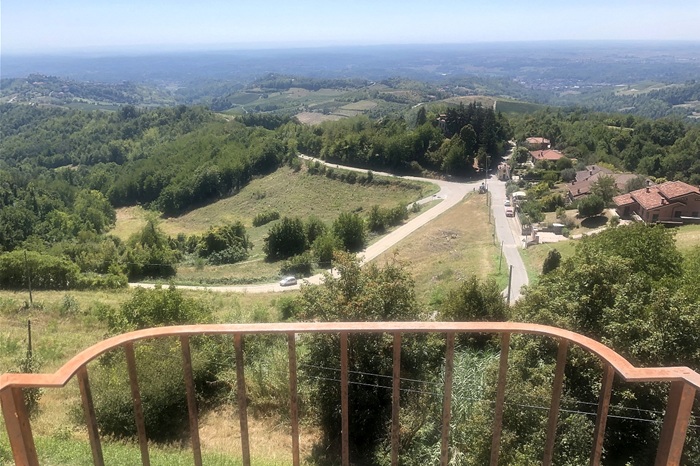
The area of Albugnano, perched on the highest hill in Monferrato at an elevation of 549 meters, rests on a unique “chalk heart” formed by sulfur springs. Clearly visible, for example, in the Moncucco gypsum quarry—which gives the vineyards their characteristic light-colored, clay-limestone soil. From the Albugnano Belvedere, one can enjoy a majestic 360-degree view with Mount Monviso in the background, which conveys an immediate sense of openness and vastness.
Between Vezzolano and Cocconato
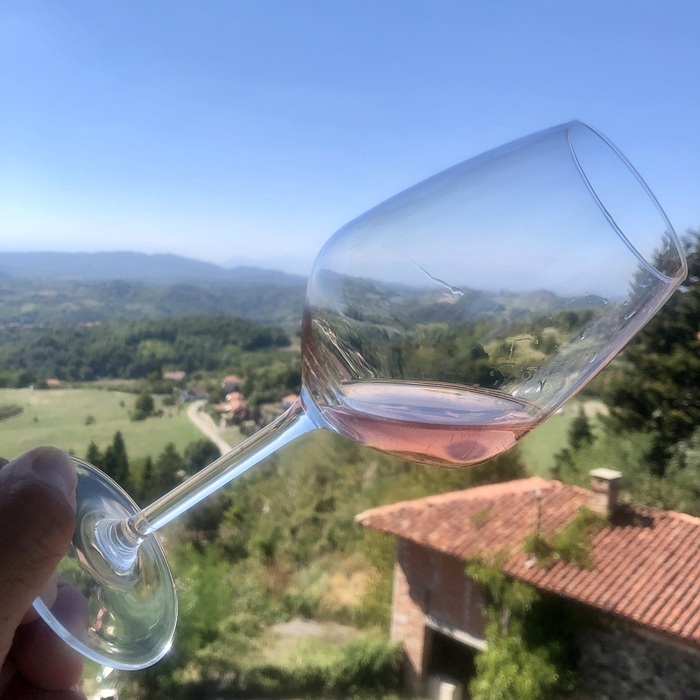 Historically established as a vacation destination with homes built on the edge of or within the vineyards, the area is also home to the monumental Vezzolano Abbey, a place that symbolizes the connection between medieval history and viticulture.
Not far away lies Cocconato, the so-called “Riviera del Monferrato” in the historical sense. Situated at an elevation of 491 meters. Its exceptionally mild and sheltered microclimate has allowed olive trees and Mediterranean plants to thrive there for centuries.
Barbera and Freisa in the local tradition
The Barbera remains one of the cornerstones of Piedmontese winemaking and, in the Asti region. Offers a wide variety of expressions, ranging from single-varietal wines to classic sub-regional blends. A high-yielding grape variety, rich in color and with pronounced acidity. It develops different nuances in the light, limestone soils to the west and the clayey soils to the east. In Albugnano, however, it accounts for about 20% of the vineyard area, producing wines that are best enjoyed especially during their first three or four years.
Alongside Barbera, the Freisa, closely related to Nebbiolo and rich in polyphenols, found one of its most widespread expressions in sparkling wines during the 1970s and 1980s. This style is well-integrated into the local cuisine: the carbon dioxide makes it easy and pleasant to drink, pairing well with the full-bodied appetizers and main courses of the Monferrato region.
Also very interesting is the small winery Malvasia di Castelnuovo Don Bosco, produced from the aromatic Malvasia Nera Lunga and Malvasia di Schierano grape varieties. It’s an ideal wine to pair with local desserts, starting with the hazelnut cake.
Nebbiolo and the Albugnano 549 Project
The star of the highest hills in this region, however, remains the Nebbiolo, which in Albugnano expresses itself in a way distinct from that of other areas in Piedmont. Native to the Alpine regions (Valtellina, the Lower Aosta Valley, and Upper Piedmont), it spread to the Turin Hills thanks to the House of Savoy. And was introduced to Albugnano through trade among sharecroppers.
To showcase this terroir, Albugnano 549. A collaborative project among 12 producers who collectively manage approximately 44 hectares. Under the winemaking supervision of Giampiero Gerbi, the goal is to produce a 100% Nebbiolo Albugnano DOC, aged for at least 18 months in oak and 6 months in the bottle. It is identified by the “Shared Bottle,” with the name engraved in relief on the shoulder.
The Riviera del Monferrato thus represents a model of regional synergy, focusing on collaboration between communities and winemakers. Altitude, biodiversity, a history stretching back millennia. And a shared vision among winemakers are the elements through which this corner of northern Asti presents itself to visitors. Offering an experience that extends from the wineries to the villages and the surrounding landscape.