
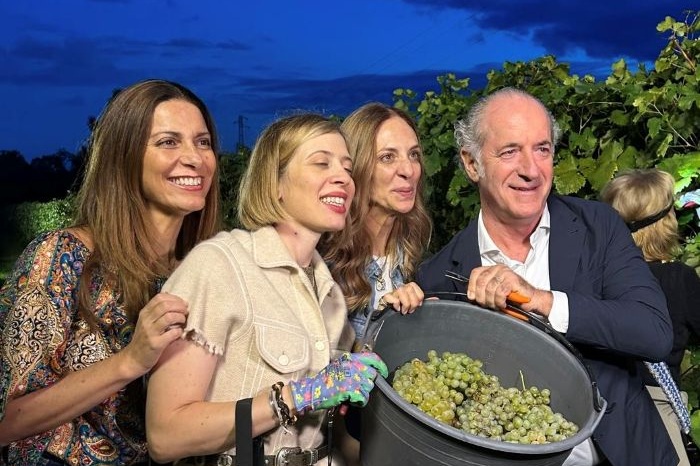

Harvesting grapes under the stars is certainly picturesque. But what if, behind that beautiful image, there were also a concrete response to climate change? At La Vigna di Sarah, in the hills of Conegliano and Valdobbiadene, twelve years of experience now meet scientific research. Chiara Giannotti tells us more.
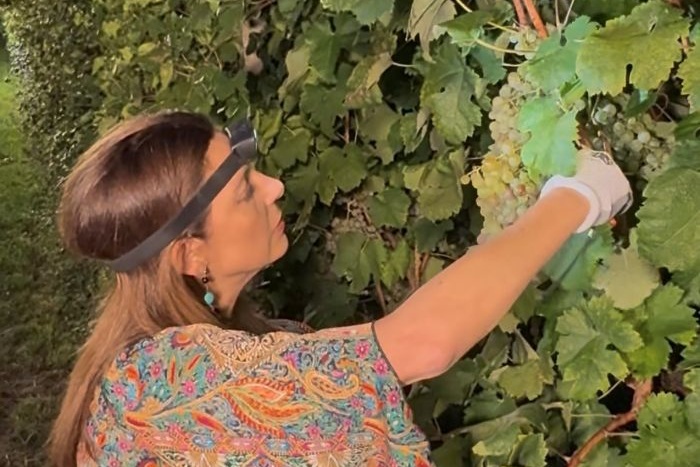
The first time you witness a nighttime grape harvest , it’s hard not to be captivated by the atmosphere. The deep darkness, the moon watching over you, the rows of vines softly lit, the silence of the sleeping world all around, and that gentle breeze that, after the heat of the day, almost seems to rejuvenate you.
It is precisely this charm that inspired Sarah Dei Tos, owner of La Vigna di Sarah, on Col di Luna in Cozzuolo di Vittorio Veneto, began experimenting with nighttime grape harvesting a full twelve years ago. But year after year, as she observed the results, a question arose: Is it really just about the allure?
Nighttime grape harvesting as a subject of scientific research
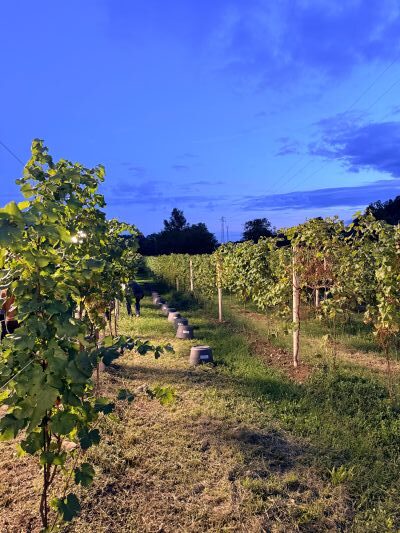
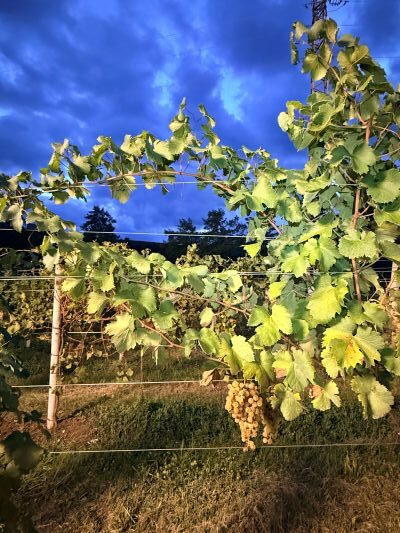
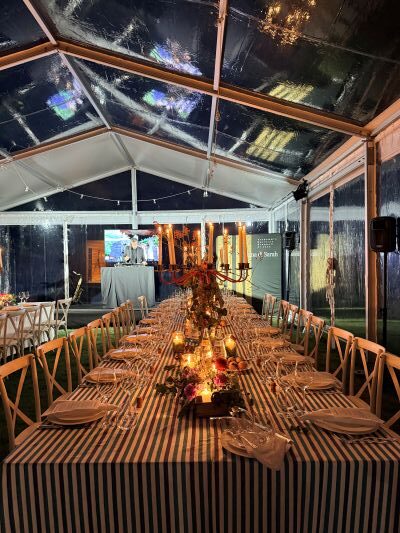

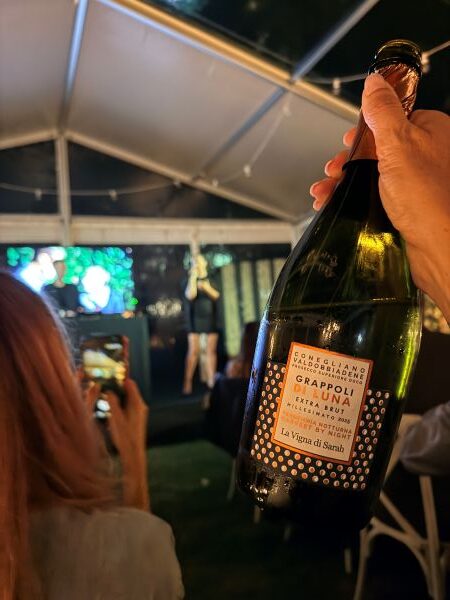
Because what began for her as little more than an intuition—which gave rise to the “Grappoli di Luna” wine—has, over time, become a practice applied throughout the entire estate. Starting with just a few rows of vines around the winery, the nighttime harvest has now expanded to all 20 hectares of the estate and has become the subject of scientific research. The harvest begins around 3:30 a.m. and ends by 8:00 a.m., allowing the naturally cooler grapes to be brought quickly to the winery.
And as the way of harvesting grapes changed, the climate around them was also changing very rapidly
Rising temperatures during the harvest season are no longer limited to the hottest regions of our country.
And it was precisely the relationship between nighttime grape harvesting and climate change that gave rise to some of the most interesting insights from the conference organized on September 18 by Sarah Dei Tos and moderated by Adua Villa.
Around the same table very different perspectives: Sarah Dei Tos’s perspective on production; the scientific and regional perspective of Diego Tomasi, director of the Conegliano Valdobbiadene Prosecco DOCG Protection Consortium; the perspective focused on landscape conservation of Marina Montedoro, president of the Association for the Heritage of the Prosecco Hills of Conegliano and Valdobbiadene; the international and entrepreneurial perspective of Marzia Varvaglione, president of the CEEV – Comité Européen des Entreprises Vins; and the institutional perspective of Luca Zaia, president of the Veneto Regional Council.
Different perspectives that all lead to the same question
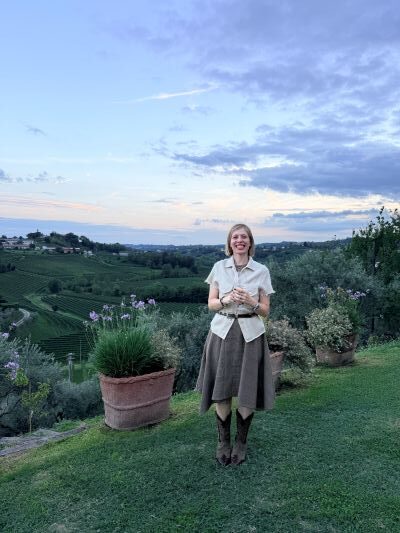

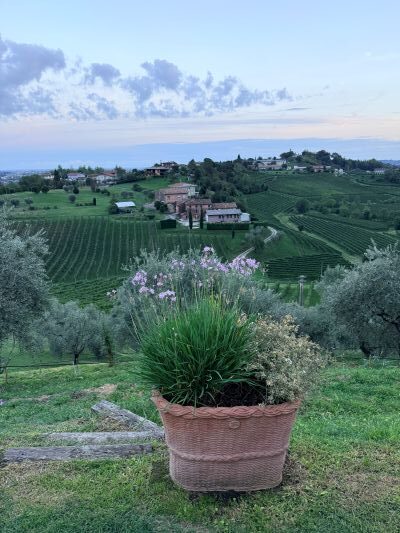
How can we continue to produce wine in the same regions if the conditions under which we have always done so are changing?
One of the statistics that struck me the most actually concerns temperatures.
In 2026, according to data presented by Diego Tomasi, there were 16 days with temperatures above 35 °C, with peaks of 37 °C. These conditions were previously projected to occur around 2040–2045. Furthermore, compared to 2003, nighttime low temperatures are expected to have risen by about 2.5 °C. But there is another figure that is even more striking: during the hottest hours of the day, the most exposed grapes can reach temperatures of around 45–50 °C.
And so the perspective changes as well

Because the problem is no longer just about understanding when the grapes have reached ideal ripeness. It becomes important to understand under what conditions those same grapes are harvested and brought to the winery.
It’s one thing to receive fresh grapes, but it’s quite another to work with batches that, after hours of exposure to heat and transport, arrive at the winery at very high temperatures. In the latter case, there is a greater need to act quickly with refrigeration, and the risk of oxidation and unwanted fermentation increases.
Harvesting during the coolest hours of the day can therefore mean less need for cooling, fewer risks, and better starting conditions for processing.
That alone would be enough to take nighttime grape harvesting out of the category of mere “Instagrammable” experiences.
But what happens to the flavors?
Here’s where things get even more interesting: Sarah’s Vineyard promoted and funded an experimental study involving CREA in Conegliano and the University of Bolzano, designed specifically to scientifically confirm what years of field experience had suggested. The protocol calls for six samplings over a 24-hour period, with the goal of observing the vine’s behavior and, in particular, gene expression and the preservation of aromatic precursors during the different phases of the day. Because the vine is not a static element of the landscape. It is an organism that continuously reacts to light, temperature, water availability, and environmental stress.
As Tomasi explained during the discussion, certain varietal aromatic compounds, including linalool and geraniol, show a negative correlation with high temperatures. Hence the interest in understanding to what extent harvesting during the coolest hours can help preserve the grapes’ aromatic potential.
And this, in my opinion, is the most important step: moving from experience to measurement. To say that grapes harvested at night are “better” would be simplistic. Demonstrating, however, which parameters change, by how much they change, and what impact they have on the winemaking process means building knowledge that can be applied beyond a single winery.
A solution for everyone? Not necessarily
It would be a mistake to turn nighttime grape harvesting into the new universal solution to climate change. Every region has its own climate, grape varieties, altitudes, training systems, and operational capabilities. And harvesting at night also presents obvious challenges: working in the dark is more complex and raises issues of organization, efficiency, and safety. This was also emphasized during the meeting by Marzia Varvaglione, president of the CEEV (Comité Européen des Entreprises Vins) and a winemaker from Puglia who has been tempted to try this approach for years: This is where technology, mechanization, and, in the future, robotics can play an increasingly important role.
In the Conegliano Valdobbiadene area, however, the issue takes on special significance, as highlighted by Marina Montedoro. We are in a hilly region designated as a UNESCO World Heritage Site, where one cannot simply respond to rising temperatures by “moving higher up”. And where the options for changing the varieties grown are also constrained by the regulations governing the appellation. Vineyard management and the choice of harvest timing therefore become particularly interesting adaptation strategies.
And it is precisely from this practical experience that the desire to obtain certification has now emerged.
La Vigna di Sarah has drawn up a set of guidelines dedicated to its nighttime harvest and has begun a process to make it recognizable to consumers through the label. The goal is to go beyond the individual winery and establish a identification system that highlights wines made from grapes harvested according to specific parameters.
But a certification only makes sense if it is based on something measurable, verifiable, and understandable. Otherwise, it risks becoming yet another sticker on a label already crammed with information. So if studies can accurately demonstrate benefits in terms of grape temperature, preservation of aromatic precursors. Energy requirements, integrity of the raw material, and working conditions, then “nighttime harvest” could cease to be merely a romantic tale of harvesting under the moon and become information with concrete substance.
Because climate change is forcing the wine industry to reevaluate many of its assumptions: altitudes, exposures, vine canopy management, water availability, harvest periods, and even the times of day when to harvest the grapes.
And maybe one of the answers was already there, simply hidden at the very moment we always thought the vineyard was dormant.
But science doesn’t take away the magic
In fact, Sarah’s enthusiasm for this tradition—which has now become an annual gathering—hasn’t waned. One evening during the grape harvest, she gathers friends, customers, and journalists among the rows of vines to let them experience this moment, followed by a dinner in the garden, enhanced by music and a live performance. That emotional element that wine must never lose—and which, in fact, represents one of its extraordinary abilities to tell the story of a region.
So, while research seeks to measure what happens inside the grapes during the coolest hours of the day, the romance that sparked it all twelve years ago remains intact.