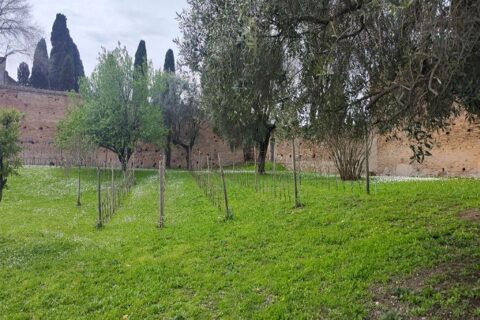
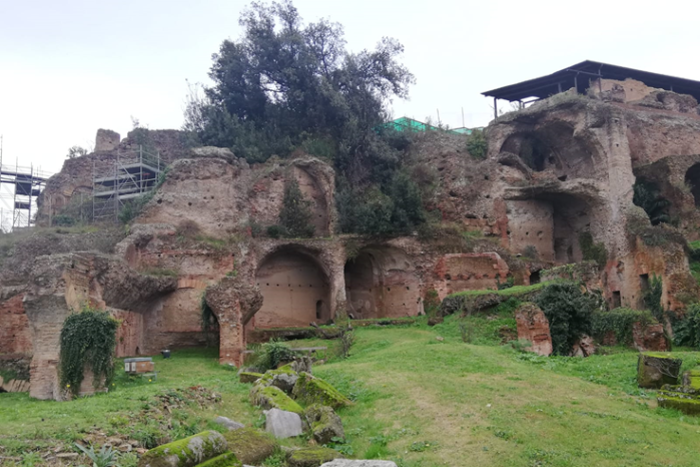

After learning about the Barberini Vineyard and AVGUSTO wine, the journey through the Colosseum Archaeological Park continues among the olive trees of the Palatine Hill, with a focus on the production of Palatinum olive oil and Ambrosia honey. This project brings together archaeology, landscape, biodiversity, and green space management, demonstrating how agriculture and historical memory can coexist in the same place.
In the first chapter of this report, dedicated to the Vigna Barberini, the focus was on the vine: a contemporary project that brings viticulture back to the archaeological heart of Rome, leading to the creation of a symbolic wine such as AVGUSTO, produced in very limited quantities and intended exclusively for institutional settings.
But that vineyard is not an isolated case.
It is part of a broader system, where the greenery of the Palatine Hill is never merely decorative or neutral. It is an element that is constructed, managed, and interpreted. A landscape that does not simply exist, but is continually reinterpreted to maintain a complex balance between nature, archaeology, and memory.
A designed landscape, not a decorative one
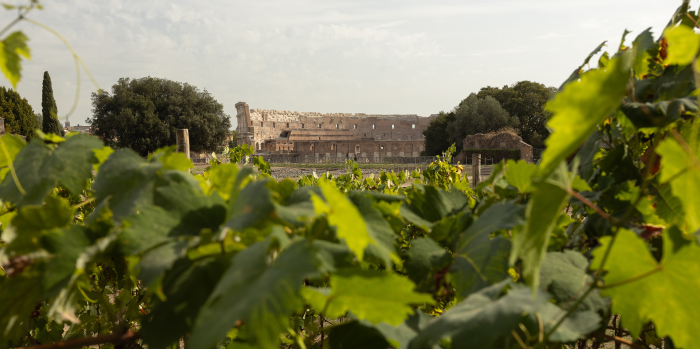
This is where this second leg begins. Just a few dozen meters from the Barberini Vineyard, the Palatine Hill continues to reveal itself for what it truly is: not merely an archaeological park, but a designed landscape, where even the trees play a part in the story.
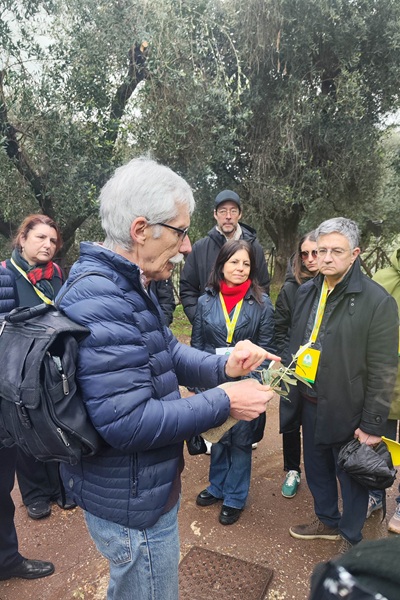
This second installment of the report is based on a firsthand experience: in April, I returned to the Palatine Hill to personally attend a lecture by Professor Riccardo Gucci dedicated to olive tree pruning in a monumental setting of exceptional importance such as this one.
Gucci is a Full Professor of Tree Crops in the Department of Agricultural, Food, and Agro-Environmental Sciences at theUniversity of Pisa. An expert in olive tree physiology and orchard management, he teaches General Arboriculture and Olive Growing and serves as President of the National Academy of the Olive Tree and Olive Oil.
But what is happening here is not a lesson in agronomy in the traditional sense. Rather, it is the rigorous adaptation of the technique to a context that imposes different priorities.
Pruning as an Exercise in Balance
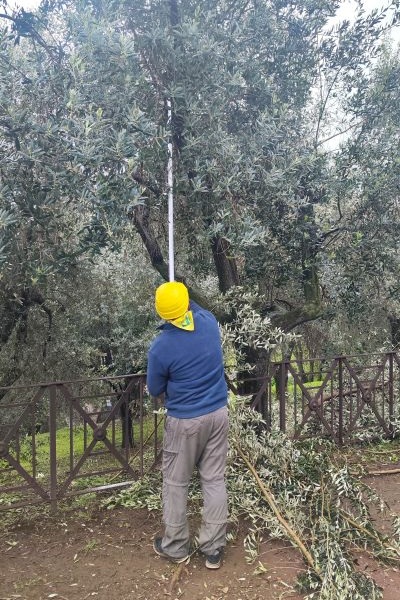
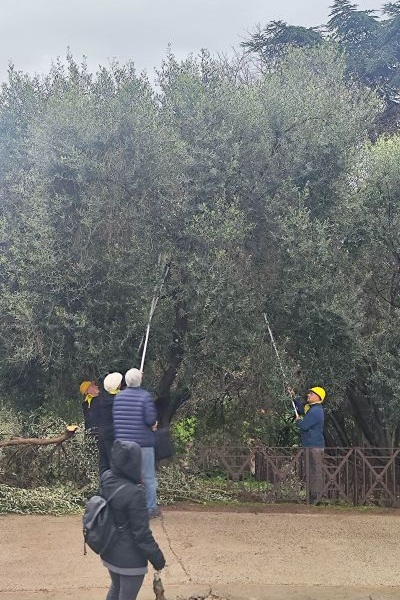
In the olive-growing manual, the polyconic shape is the standard model. On the Palatine Hill, however, this shape is significantly scaled down. The olive trees are deliberately kept shorter and the canopy is thinned out in the center to prevent any excessive density.
The result is an open structure, through which light can pass. Not full shade. Not direct sunlight. But an intermediate state, to be precise: a sort of “shadow that is not a shadow.”
Light filters through, passes through, and casts patterns on the ground, and reveals the archaeological structures. In this context, pruning serves first and foremost the plant—its stability, longevity, and physiological balance—but consciously forgoes productivity as its primary goal.
The 189 olive trees on the Palatine Hill are not an olive grove in the agricultural sense of the term. They are part of a more complex system, in which Vegetation and architecture coexist in harmony.
But today, this system is evolving.
Palatinum Oil Is Born
The Colosseum Archaeological Park has, in fact, launched a project that goes beyond the simple management of green spaces: a model for enhancement that integrates landscape, production, and outreach. So it’s not just about archaeology, but also about health, well-being, and local culture, based on a short-chain, zero-kilometer approach.
It is in this context that Palatinum olive oil, produced from the olive trees on the hill. It is not merely a matter of recovering the olives, but of avoiding waste, improving site management, and transforming a potentially problematic element—the olives that have fallen along the paths—into a cultural and agricultural resource.
Production thus becomes part of a broader program, which includes educational activities on olive cultivation, the history of olive oil, and its significance in Roman civilization.
Ambrosia on the Palatine Hill and the Value of Biodiversity
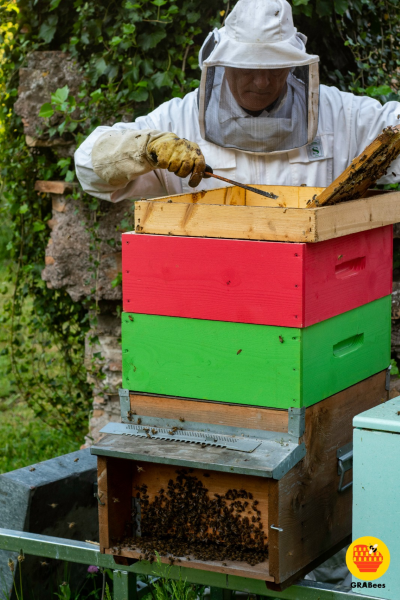 Alongside the olive oil, another project has taken shape: honey production, the “Ambrosia del Palatino”. The beehives were placed along the southern slope of the hill, in an area with particularly lush Mediterranean vegetation.
Ancient sources—Varro, Columella, Pliny the Elder, and Virgil—describe with surprising precision the ideal conditions for beekeeping: dry, well-ventilated places, rich in essential oils, and far from human disturbance. The beehives on the Palatine Hill follow these guidelines exactly.
Here, too, production is not the main goal. Honey, which has been associated with ambrosia—the food of the gods—since ancient times, becomes a symbol and a tool for reflecting on biodiversity and on the vital role of pollinating insects, which are increasingly under threat today.
A living system that tells the story of ancient Rome
In this setting, even the olive trees take on a different meaning. They are not just elements of the landscape. They are not just a reminder of the past. And are part of a living system that seeks to reconstruct, in a contemporary form, the the relationship between humans, nature, and the city that characterized ancient Rome.
This balance is complemented by a comprehensive management system with clearly defined responsibilities. The central point of reference for all the green spaces on the Palatine Hill is the Landscape Architect Gabriella Strano, a long-standing figure within the Colosseum Archaeological Park, who continuously oversees its overall direction, decisions, and consistency.
Alongside this production, there is a collaboration with Nicola Di Noia, President of Coldiretti, and with Coldiretti itself—an entity external to the Park—which is entrusted with the operational management of most of the olive trees.
This is a functional partnership that has been built over time, in part through constant technical exchange, yet it operates within a well-defined framework: that of a landscaping project whose vision and responsibility remain firmly within the Park.
Olive oil is produced from the olive trees on the Palatine Hill. But it is not a product in the commercial sense. It has no price and no market. Like the AVGUSTO wine from the Barberini Vineyard, it is intended exclusively for institutional contexts.
Production does not determine choices. It is a consequence of them.
A project that tells the story of the landscape
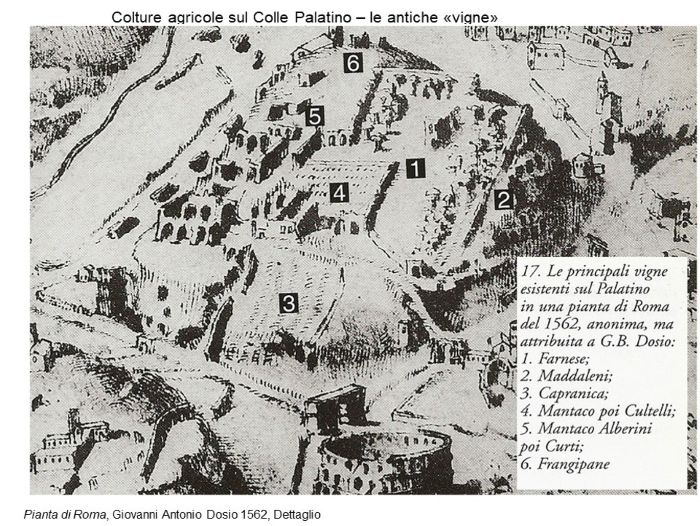
If one were to summarize what happens on the Palatine Hill, one could put it this way: here, greenery is not cultivated for production, but to tell a story.
And pruning, more than just an agricultural task, becomes an act of balance: between plant, light, and memory.
I hope that, upon returning to the Palatine Hill, readers will be able to see the more than two thousand plants that grow there.
Nothing here is left to chance. Every tree, every olive tree, every choice of plant is the result of a vision that holds it all together history, landscape, and culture. A vision that has taken shape over time, through decades of work, and which today finds its focal point in landscape architect Gabriella Strano, in ideal continuity with those who came before her.
The Palatine Hill isn’t just a place to visit. It’s a place to explore. And perhaps, for that very reason, it’s a place to take your time observing.