
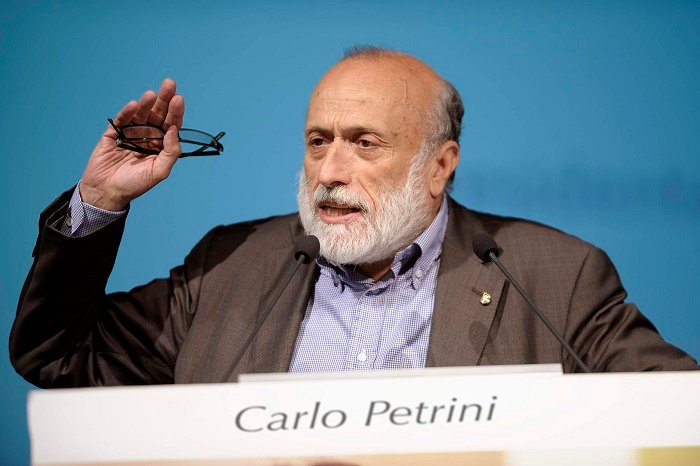
After a long illness, Carlin Petrini, the farmer who made the world change its perception of food and influenced the international debate on the relationship between humans, food and the environment, died tonight.
There is a piece of Italy that without Carlin Petrini would never have existed. Not the Italy of large food industries or labels constructed by marketing, but that of taverns, small producers, marginal countryside, forgotten cheeses, peasant wines and knowledge passed down at the table. An Italy that Petrini has transformed into political, social and gastronomic culture.
Who was Carlin Petrini
Born in Bra, in the Langhe region of Italy, in 1949, Carlo “Carlin” Petrini was much more than a gastronome. He was an organizer of ideas, a cultural agitator, a popular intellectual capable of transforming food into a universal language. With Arcigola then Slow Food, officially founded in 1986 after the symbolic protest against the opening of McDonald’s in the Spanish Steps, he built one of the best known Italian movements in the world.
His insight was both simple and revolutionary: food is not just any commodity. Behind every product are territory, biodiversity, labor, memory and dignity. Hence the “good, clean and fair” manifesto , which has become an international flag over the years.
Spokesperson for the voiceless
Petrini gave a voice to those who had none: small ranchers, farmers, wine artisans, producers destined for economic and cultural extinction. Slow Food Presidia, Terra Madre, and the University of Gastronomic Sciences in Pollenzo were the concrete tools of a battle that united environmentalism, agriculture, and the pleasures of the table.
But Carlin was also a unique character: burly, ironic, histrionic, able to move from Piedmontese dialect to international conferences, from provincial taverns to UN tables. As naturally as telling a salami he could talk about climate change, agricultural speculation and food poverty.
His cultural legacy
Many considered him a visionary. Others a moralist of taste. Certainly he was one of the very few Italians capable of truly influencing the world debate on the relationship between man, food and the environment.
Before the words “sustainability” and “ecology” came into common parlance, Petrini had already shown the way: save the earth by starting at the table.
And perhaps his greatest legacy is precisely this: having taught that eating is not a trivial act, but a cultural and political act.

