
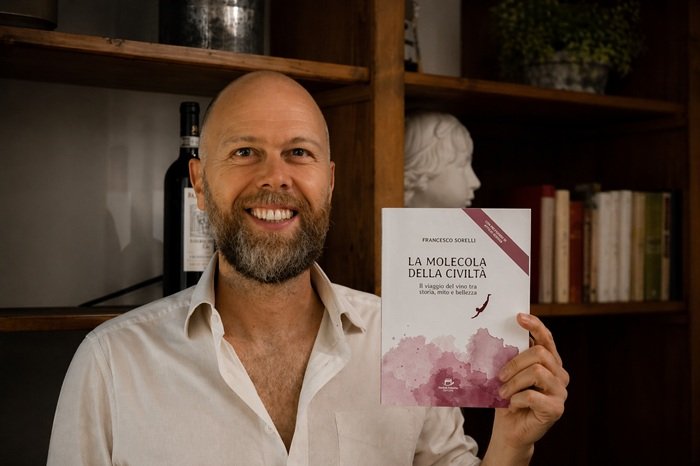
The Molecule of Civilization proposes a reading of wine as an interpretive tool of human history. An ambitious operation that intercepts a gap in contemporary wine discourse: much technique, little cultural elaboration.
When Director Cernilli turned this book over to me to read, I did not think I would be faced with such an articulate work. I knew Francesco Sorelli as a communicator and manager, and I did not expect such an approach.
The book The molecule of civilization by Sorelli does not fit into the usual patterns of wine literature. It is not a manual, nor is it a systematic history of wine. It is a hybrid essay that uses wine as an axis to traverse broader themes: history, religion, society, symbols, consumption.
This out-of-the-box approach sets him free. The author privileges connections and suggestions compared to the demonstrations. The end result is somewhat uneven, but readable and accessible. Breadth of the project understandably results in some weaknesses, but the narrative construction convinces.
Neither specialized technique nor simplified narrative
The value of the book lies not so much in the thesis-wine as a “molecule of civilization”-as in the need it reveals: Bringing wine back into a broader cultural discourse. In recent years, wine communication has been divided between two poles: on the one hand, the specialized technique, and on the other, the simplified market-oriented narrative. In both cases, the space for a cultural analysis has shrunk.
Sorelli interjects right here. With an extremely pleasant narrative approach, cultural depth and knowledge.
Wine as a social device
One of the most solid points of the book is the idea of wine as a system of meanings, not just as a product. Wine is treated as a social device: it builds relationships, encodes behaviors, reflects hierarchies. It becomes a key to reading the relationship between individual and community, between consumption and culture.
The most relevant aspect concerns the present. The molecule of civilization implicitly proposes a critique of the way we talk about wine today: reduction to product, loss of context, simplification of language. In this framework, the appeal to concepts such as. measurement, time and relationship Is not ornamental. It is an attempt to redefine the role of wine in a culture that tends to neutralize its complexity.
The molecule of civilization does not offer a stable theoretical model. It does, however, offer a clear signal: there is a space, now sparsely occupied, for a cultural reflection on wine that goes beyond technique and marketing.
The book does not close the discussion. It reopens it.
PS. “The Molecule of Civilization – the journey of wine among history, myth and beauty,” Francesco Sorelli, publisher Davide Falletta, €34.90.