

Professor Fino’s proposal, which editor Cernilli also mentioned in the last editorial, does not please the Lombard producers of either appellation called into question. Saying no means defending the identity of their appellation, be it Franciacorta or Oltrepò.
The idea of a “Grande Franciacorta,” a Lombard designation of sparkling wines on the model of the Prosecco system, remains an academic hypothesis for now. In fact, producers from the two territories involved – Franciacorta and Oltrepò Pavese – strongly reject the proposal put forward by professors Michele Antonio Fino and Carmine Garzia of the University of Gastronomic Sciences in Pollenzo.
The proposal: a broader designation
The discussion stems from a study entitled. Regulatory Innovation and Sustainable Growth Strategies in the Wine Industry: The Case of an Italian Sparkling Wine Designation of Origin., authored by Fino together with his colleague Garzia.
According to the two scholars, production specifications are not just a set of technical rules, but can become tools of territorial and industrial policy. In this perspective, a geographical reorganization of appellations could foster sustainable growth of Lombardy’s sparkling wine districts.
Taking its cue from the evolution of the Prosecco system, the study hypothesizes the creation of a broader appellation, called “Grande Franciacorta,” capable of integrating several territories with a vocation for classic method production, including Oltrepò Pavese. The goal would be to create greater critical mass and strengthen presence in international markets.



Two territories, two different paths
Fino and Garzia’s thesis starts from the idea that two partly complementary systems exist in Lombardy.
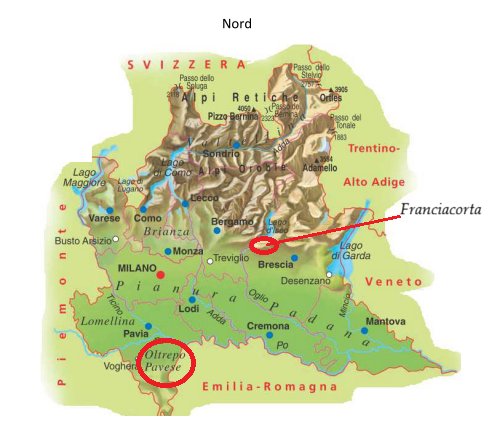 On the one hand, Franciacorta, an appellation that has built a strong reputation and premium positioning in recent decades, but is spread over a relatively limited and densely populated territory.
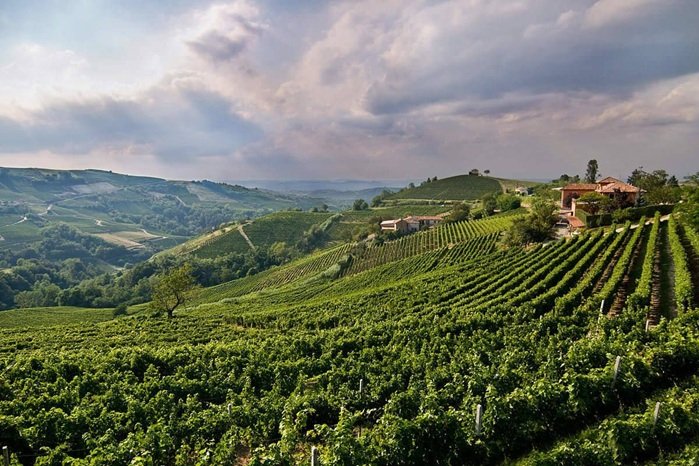
On the other is Oltrepò Pavese, one of Italy’s largest wine-growing areas with about 13,000 hectares of vineyards and 3,000 hectares of Pinot Noir, the largest area devoted to this variety in the country. Despite this potential, Oltrepò’s Metodo Classico Docg now produces just over 2 million bottles a year (of which many are downgraded), numbers far lower than the 20 million in Franciacorta.
According to the authors, a broader appellation would allow for growth without increasing land pressure in the historic territory of Franciacorta. In this scheme, the current DOCG would become Franciacorta Superiore, the premium level of a multi-tiered structure.
Franciacorta’s response
From the Franciacorta Consortium, the response is immediate and rather sharp.
“We don’t want ‘Grande Franciacorta’ because Franciacorta is already great,” says President Emanuele Rabotti, according to whom the appellation does not have a problem with space or growth.
“Since 2011, our consortium has had an economic observatory that analyzes Franciacorta marketing data in Italy and abroad. We always know when, where, to whom and at what price our wine is sold and therefore can regulate production “.
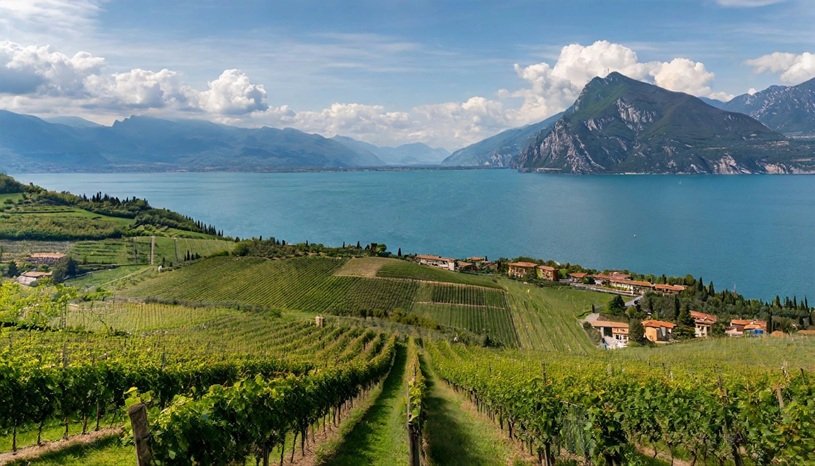
Today the appellation produces about 20 million bottles a year, but there is still room for growth, according to Rabotti. “We could reach 30-35 million bottles without creating negative environmental impacts.”
If territorial expansion were ever to be considered, he adds, the direction would still be a different one. “It would be more natural to look northward, toward Valcamonica, with which there is geological, geographical and microclimatic continuity. Oltrepò is a beautiful territory, but we are different “.
Oltrepò also says no
Not even from the other side of the hypothetical “Great Franciacorta” comes opening.
According to Francesca Seralvo, president of the Oltrepò Pavese Consortium, the idea does not take into account the evolution of the sector. “Fino’s study has economic underpinnings, but it takes up projects already attempted in the past, such as those of the Italian Classic Method Institute or Talento.”
Today, however, Seralvo argues, the context has changed. “Over the past three decades, awareness of territorial identity has grown everywhere. Such a project would only work with strong cohesion among the territories involved, something that does not exist today “.
Rather, the way forward for Oltrepò Pavese is to relaunch its identity. “At Vinitaly the Classese project will start, and that is the tool with which we will relaunch our classic method and Pinot Noir.”
Paolo Ziliani’s point of view
An interesting look comes from Paolo Ziliani, of Berlucchi, who knows both territories well. Indeed, the Ziliani family is historically rooted in Franciacorta but in recent years has also invested in Oltrepò Pavese.
“They are two different territories, both of great value,” he notes. Franciacorta, Ziliani explains, has built a strong international reputation in recent decades. Oltrepò, on the other hand, is trying to emerge from a period of tarnish and make its potential known. It is precisely from this need that the Classese project was born, the classic method from Pinot Noir that aims to enhance the vocation of the Pavia area.
Ziliani also envisions a precise stylistic development. “In my opinion, the future of Oltrepò is Cruasé, the rosé sparkling wine that can best interpret the relationship between terroir and grape variety. I dream of the day when Cruasé becomes the world benchmark for rosé bubbles. “.
But on the hypothesis of a common appellation, he leaves no room for doubt. “To think that Oltrepò Pavese could become the basin from which to draw grapes for Franciacorta is offensive to both territories.”
Two different roads
If the idea of Grande Franciacorta today does not convince either Brescia or Pavia, the debate opened by Fino and Garzia’s study remains interesting nonetheless.
Indeed, the underlying question remains on the table: how can Lombardy’s metodo classico grow in an international market dominated by Champagne and Prosecco?
For now, the territories’ response is clear.
Franciacorta and Oltrepò Pavese prefer to continue to grow by following different paths, each with its own identity.