
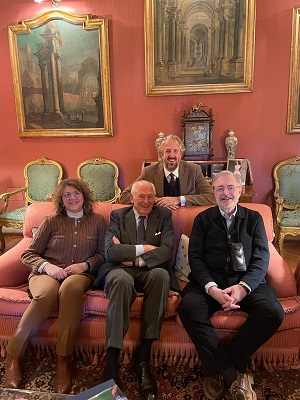
In the aristocratic halls of Palazzo Taverna, the Roman residence of the Marquis Guerrieri Gonzaga, we were able to hold-exclusively for DoctorWine-a wonderful vertical tasting of all the vintages produced of the great Trentino Bordeaux: San Leonardo.
Rarely does a wine so closely resemble its producer as in the case of San Leonardo. I understand, it may sound a bit crazy, but how else to explain the elegance, the class, the gentleness, the sobriety of this magnificent wine if not by looking at who produces it? Marquis Carlo Guerrieri Gonzaga and his son Anselmo are just like their wine, and this, although it cannot be explained scientifically, must make sense.
What is San Leonardo
For those not familiar with it, San Leonardo is a wine made from a Bordeaux blend, produced since 1982 in Trentino, in Borghetto d’Avio, in the area that from the unification of Italy to the end of World War I marked the border with the Austro-Hungarian Empire. To be clear, we are further north than Bordeaux. This is the area of the Campi Sarni in Vallagarina, a unique territory with mountains towering above the hills and nearby Lake Garda mitigating the cold, which ensures a cool, dry microclimate.
Carlo Guerrieri Gonzaga had studied oenology and worked as a young cellarman at Tenuta San Guido in Bolgheri, at his uncle Mario Incisa della Rocchetta, before Giacomo Tachis arrived as a consultant and gave Sassicaia its final shape. It is clear that the idea of a Bordeaux-style wine was in his heart and experience. As he began to take charge of the family winery, this model was well in place, and the San Leonardo demonstrated this from the very first vintage. Initially there was Carmenère (mistaken for Cabernet franc) and Merlot, which had been on the estate since the 1960s, and Cabernet sauvignon, which had been planted in ’78. Then, in the early 1990s, the real Cabernet franc arrived and they understood the misunderstanding that had always been there in the area, but they did not remove Carmenère from the blend, since it has always been a characteristic of San Leonardo.
The succession of two great winemakers
Who could one ask for enological advice for this wine if not Tachis? He followed him until 2001, when he left his hand to Carlo Ferrini, without substantially changing anything in the style of the wine. That year also coincided with Anselmo Guerrieri Gonzaga joining the company, equally passionate about the countryside and production, as capable and brilliant as his father.
San Leonardo, like all great wines, “feels” the vintage, but otherwise we could say that it is an unchanging wine with its inherent characteristics and personality so Bordeaux and so Trentino at once. Balsamic and elegant, fresh and balanced. One of the greatest Italian reds that manages, year after year, to agree with the critics and always place at the top of the guides’ “superclassification.” (For the record, this year by cross-referencing the Italian guides and international critics’ scores, it placed sixth among the best 100 Italian reds).
Very simple processing: spontaneous fermentation in small concrete tanks for about 2-3 weeks with several daily pump-overs and délestage. About 24 months in French oak barrels of first, second and third passage.
The complete vertical of San Leonardo
We see today the first 10 vintages produced, from 1982 to 1994 (some vintages were not produced). For the later ones the date is tomorrow and after. To read the sheets, click on the name.
- San Leonardo 1982 (Table wine from the Campi Sarni)
- San Leonardo 1983 (Table wine from the Campi Sarni)
- The 1984 vintage was not produced
- San Leonardo 1985 (Table wine from the Campi Sarni)
- San Leonardo 1986 (Table wine from the Campi Sarni)
- San Leonardo 1987 (Vallagarina Table Wine)
- San Leonardo 1988 (Vallagarina table wine)
- The 1989 vintage was not produced
- San Leonardo 1990 (Table wine from Vallagarina)
- San Leonardo 1991 (Table wine from Vallagarina)
- The 1992 vintage was not produced
- San Leonardo 1993 (Table wine from Vallagarina)
- San Leonardo 1994 (Table wine from Vallagarina)