
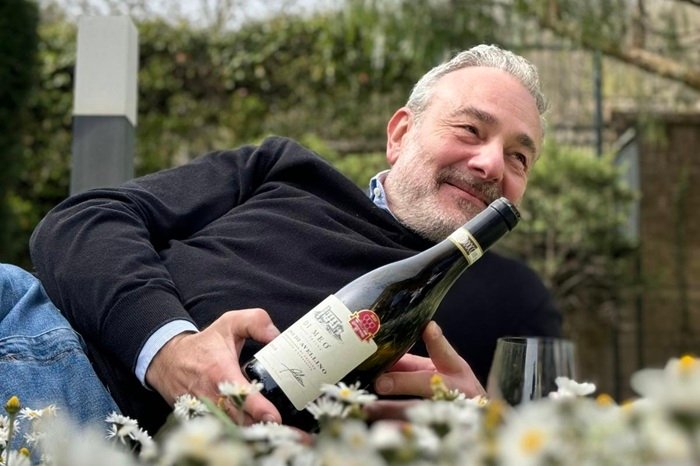
Reduction winemaking to enhance the aromatic characteristics of Irpinian grape varieties. Producing wines that defy time. In conversation with Roberto Di Meo to learn his secrets. For us, Antonella Amodio.
Fine winemaker and refiner of white wines of rare longevity, Roberto Di Meo is the technical and creative soul of the family winery. His labels-such as the Fiano di Avellino Alessandra or Erminia and the Greco di Tufo Vittorio, awarded in various editions of the Essential Guide to the Wines of Italy – have become true references for those seeking the longest-lived white soul of enoic Irpinia, not to mention Taurasi Riserva Hamilton and Vino Blu.
It all started in the early 1980s, when Roberto, together with his siblings Erminia and Generoso, took over the historic family estate in Salza Irpina, once owned by the Caracciolo Princes. It is here, among breezy hills and an ancient 18th-century hunting lodge, that the Di Meo project takes shape: to produce great wines from native varieties Fiano, Greco and Aglianico., and preserve, through wine, the cultural heritage of the area.
In 1986 came the first bottles signed Di Meo. While Irpinia conquered the national scene in 1993 with Docg Taurasi, the winery establishes itself as one of the most representative in Campania, through white wines: Fiano di Avellino and Greco di Tufo that leave the cellar after a very long stay in steel, on fine lees, a challenge to highlight the potential of Irpinia’s native varieties.
Today the leadership is in the hands of Roberto, winemaker and sales manager, and Generoso, creator of the “Di Meo Wines to Art.” which combines wine with the cultural enhancement of the territory. A double track – taste and memory – along which their idea of territory runs: to be told, to be drunk, to be passed on.
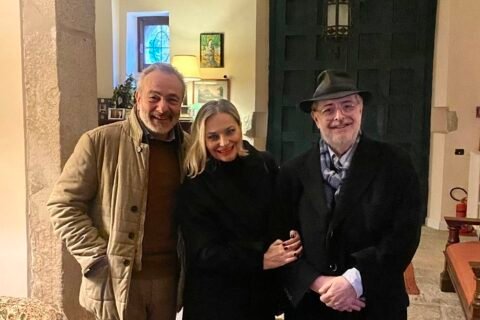
While waiting for the release of the 1993 vintage Fiano (it will have no appellation), which we tasted in preview with Daniele Cernilli, we interviewed him to learn the secrets of the longevity of his wines.
Roberto Di Meo, let’s go back to the beginning, from when you took your first steps in the company…
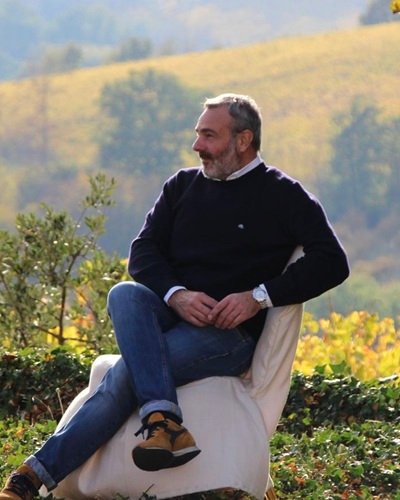
When I inherited the family business, my first goal was to systematize and rationalize the historic vineyards. It took me several years to fully understand the potential of both the grape varieties we grow and the different vineyards we manage, located in Salza Irpina, Montemarano, Montefusco and Santa Paolina. The idea was to approach an increasingly specialized viticulture, starting with the recovery and modernization of the plants.
Let’s start with Fiano: where is it grown?
A Salza Irpina We have replanted almost everything over time. We grow Fiano on clay-limestone soils, between 500 and 550 meters above sea level, using the guyot system. Here I adopted a parceling system, using different rootstocks and modulating the density of the plantings between 3500 and 5000 vines per hectare. The presence of clay and limestone promotes a good water reserve and an ideal exchange of substances for the plant, while the temperature ranges between day and night help to concentrate the aromas in the skins.
What about the Greco?
We grow it in the vocated areas of Montefusco and Santa Paolina, on soils that are always clay-limestone but with pumice and tuffs of volcanic origin, due to ancient Phlegraean eruptions. The altitude reaches up to 750 meters, particularly for the vineyard destined for the Vittorio Reserve. Here the microclimatic conditions-woodlands, waterways, ventilation-allow us to slightly over-ripen the grapes and have a yield of about 50 quintals per hectare. All ideal elements for obtaining healthy, aromatic and long-lived grapes.
You make Aglianico in a very particular place, don’t you?
Yes, in the historic Olmo vineyard in Montemarano, in the heart of Taurasi Docg. It is the highest vineyard in the entire area, at about 900 meters above sea level, with a strongly continental climate and a wide temperature range. The soils are rich in skeleton, which allows us to harvest even as late as November. The result is grapes with great acidity, a good alcohol content and a very interesting polyphenolic makeup, ideal for the production of an important reserve.
How does all this work in the vineyard translate into your approach in the winery?
Over time we realized that some of our wines needed longer aging to express their full potential. For this reason, as early as the 1990s, I began to indulge in time: not only with vintage wines, but also producing reserves of Fiano and Greco destined for Maturing for decades in the cellar.
Is it in this context that the choice of reduction winemaking was born?
That’s right. After experiments with more traditional techniques, today we prefer vinification by reduction, to To preserve the aromatic characteristics of the grapes as much as possible. Given the diversity of our vineyards, we “portion out” the harvest, picking only the healthiest and most intact clusters during the coolest hours of the day to best preserve acidity and aromatic precursors.
What techniques do you use in the winery to protect the grapes and must?
Once in the cellar, we cool the grapes with dry ice to lower the temperature. We leave the crushed grapes in contact with the skins directly in the press for a few hours to extract the aromatic component, then we press softly. The must ferments slowly in steel at 13-14°C, for about 20-22 days: it is a slow fermentation, which promotes the development of aromas of fresh fruit and flowers.
How do you manage the refinement of reserves?
After fermentation, the wine is racked to remove coarse lees. For reserves, we leave the wine on the fine lees for several years, depending on the vintage and the desired result. We stir them frequently at first, then less and less, constantly monitoring the oxygen in the tank. When necessary, we saturate the headspace with nitrogen, to maintain the reduction.
What emerges over time from these reduction vinifications?
The reserves of Fiano and Greco we produce with this technique evolve in a very interesting way: savory, graphite notes and smoky nuances emerge., yet always keeping the acidity alive. It is a process that brings out the inherent complexity of these grape varieties, making them unique and long-lived.
One last question: is there a message you want to leave behind for those approaching viticulture today?
I think it is critical not to be in a hurry And know how to listen to both the vineyard and the wine. This is the only way to respect the potential of our territory, which still has so much to express.