


A birthday party becomes an opportunity to reflect on contemporary wine, Cesanese del Piglio and the value of memory, storytelling and “rural heroes.” Through the vertical of Colle Forma, Giovanni Terenzi’s story is intertwined with the evolution of a territory.
Fortunately, I waited a few days before writing this piece. Otherwise it would have been just an account of a beautiful day of celebration for the 80th birthday of a producer, Giovanni Terenzi. In the meantime, however, Daniele Cernilli published his editorial Wine world: a complex picture and this article of mine has taken a different, broader direction. If you are willing to go all the way through, you will understand why.
But let’s go in order.
The invitation and promise of a great vertical

Toward the end of October, as we tasted dozens of Cesanese wines – from Piglio, from Affile, from Olevano – our friend Pasquale Pace, aka The Wandering Gourmet, asks me if I would like to attend the 80th birthday party of Giovanni Terenzi, a true noble father of the territory. I had drunk a few of his bottles in the past, recently testing some of his production for the Essential Guide to the Wines of Italy 2026, but I had never encountered it or addressed its production organically.
Pasquale’s promise was tantalizing: a vertical tasting of ten vintages of the Colle Forma, Cesanese del Piglio Superiore DOCG, the winery’s flagship wine.
The thing besides being pretty was beginning to be really interesting.
The meeting with Giovanni Terenzi

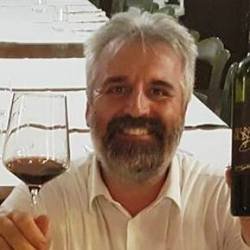
I arrive at the winery early in the morning. I introduce myself to Giovanni, who greets me with a smile and I reciprocate with a bottle of 2012 Verdicchio, hoping he will appreciate it. A quick glance at the winery, at the landscape visible through the large windows of the tasting room, then everyone sits down in anticipation of tasting the ten vintages chosen from among the most representative of an oenological journey that is by no means taken for granted.
Joining us to celebrate John are. his daughter Pina, president of the Cesanese del Piglio DOCG Consortium, his son Armando, who follows somewhat all production operations with his father, several grandchildren, the historic oenologist Roberto Mazzer and about 30 employees. A family before a business.
Cesanese before Colle Forma
Before the tasting, the story of Colle Forma is told. And it is a story about the entire relatively small area and its three appellation wines: Cesanese del Piglio DOCG, Cesanese di Olevano Romano DOC and Cesanese di Affile DOC.. (Rhetorical question, won’t three appellations be too many for such a small territory with so few hectares under vine?)
At one time, a a sweet, sometimes sparkling red wine, to be drunk very young, from November onward. It was a beloved wine in Rome but unstable, often re-fermenting violently in the bottle, causing it to explode and stain all the walls of the cellars, much to the delight of the local painters who were always busy!
Giovanni Terenzi, however, saw beyond that.
The birth of a “serious” red


Convinced of the potential of Cesanese, Giovanni decided to try a new path: a dry, structured red, capable of aging. With the help of the then young winemaker Roberto Mazzer – who at the time had never yet worked with Cesanese – he entered a virtually unexplored territory, with no reference literature, made of intuitions, mistakes, trials and corrections.
Tales of thinning done on Ferragosto on the sly by the father-in-law, out of cultural bearing averse to the very idea. Of generational clashes, of tradition and visions confronting each other. Episodes told with genuine candor, making people smile but explaining everything the love for this land and these grapes on the part of John and his family (of which the winemaker is also a good part).
Ten vintages of Colle Forma
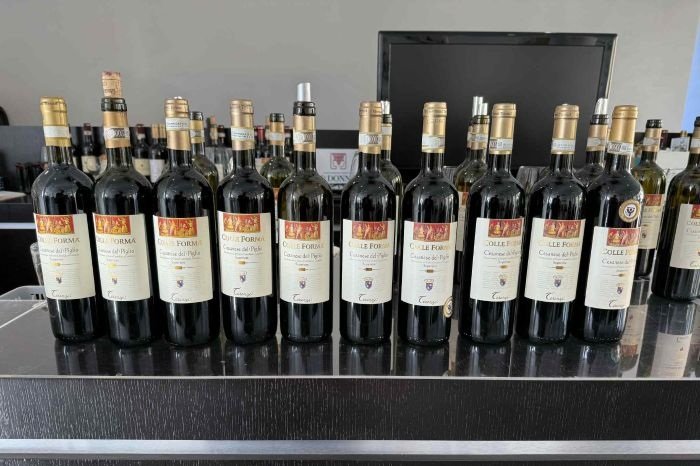
The Colle Forma comes from a vineyard planted in 1997: 100% Cesanese, slightly overripe grapes, maceration for about 25 days, 18-month aging in large 20-hectoliter Slavonian oak barrels.
Ten bottles, all bright purplish-red color more or less dark. Elegant tannins, not too dense, except for the 2015 which is almost unique in this, and a clear stylistic thread. The 2010, the oldest one in the tasting, is also the most convincing: peppery mouthfeel, lively freshness still lashing out, and a sip of excellent persistence.
The most recent vintages open a reflection on climate change: by all it is seen as an eternal damnation. Instead, in my opinion, in these areas, with these soils and these grapes, warming has led to fuller ripening and to more balanced, sunny, Mediterranean wines, pleasant and fragrant.
Perhaps with fewer quality peaks, whether positive or negative, but more pleasant and immediate. And wine, after all, is meant to be drunk and shared.
Wine as narrative, not ego
Because wine should be produced to be drunk (and sold) and not to satisfy the ego of this or that producer or winemaker. Research and targeting consumer tastes, if it does not distort the essence of a product, an area, an appellation, should not be demonized.
Similarly, storytelling should be encouraged: knowledge of stories, families, rural rural heroes, who make us laugh and move when we hear them narrate their own “enoic chanson de Roland.”. Like today, when Romano, John’s son, tells us that we were lucky: it rained a little today and therefore 80-year-old Giovanni could not go with the tractor into the fields. That is why the surprise party turned out so well!
With these stories, with these examples, wine becomes history, culture, quasi-epic narrative, memory. It continues its millennia-long coexistence with man, overcoming fashions, falsely healthy dietary diktats and the ideological crusades of the no-alcohol potentates.
Because we need to listen
Perhaps today we need more than ever to listen to those who make wine and then tell the story of who, how, and when a particular wine was made. And only then delve into a technical description of it. Storytelling – oral, written, in pictures – fascinates, engages, even as children.
Wine must return to being authentic pleasure and shared history.
And you who read, visit these rural heroes of ours. Talk to them, drink their wines. You will hardly spend your time – and your money – better.