
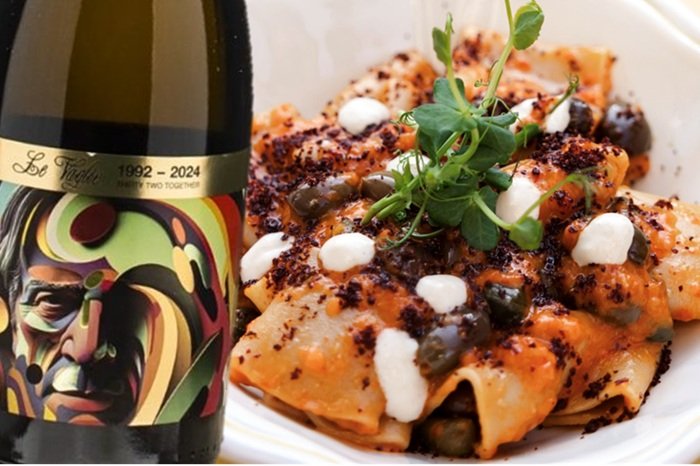
A lively dish where the roasted sweetness of the bell peppers meets the savoriness of the taggiasche olives and the unexpected delicacy of the almond sauce. We pair it with Verdicchio Castelli di Jesi Classico Le Vaglie 2024 Santa Barbara, where we find freshness, savoriness and an almondy finish that directly recalls the almond sauce.
This recipe is signed by Andrea De Vita, chef and culinary director of Via Pasteria, the fresh pasta format in Milan that in three years, with four locations, has won more than 20,000 reviews on Google.
Ingredients for 2 persons:
- 120 g paccheri
- 1 kg raw red bell peppers (yield: 500 g cooked and skinned)
- Half a clove of garlic without a soul
- 3 basil leaves
- 5 g capers (for 100 g of pasta)
- 10 g drained taggiasca olives (per 100 g dough)
- 3 g salt
- Aged Parmesan cheese 24/36 months q.b.
- Extra virgin olive oil
- 100 g peeled almonds
- 200 g almond milk
Directions:
For the cream of bell peppers
Select only red bell peppers, wash them well and place them in the oven for 20 minutes at the highest ventilated temperature. Without oil or anything else, just well washed and dried.
As soon as they are baked, place the peppers in cuki bags to create condensation and make it easier to remove the skin. Then, under cold running water, thoroughly remove the seeds and remaining skin.
Blend all the peppers with a clove of half a soulless garlic, 2 or 3 washed basil leaves and salt to taste.
For a smoother cream, little oil can be added while blending the mixture.
For the almond sauce
Blend all the peeled almonds, then add the warm almond milk. Continue blending until a smooth sauce is obtained.
Preparation in a frying pan
Sauté a drizzle of oil with a clove of poached garlic and 2 basil leaves. Remove the scents and add plenty of cream of bell bell pepper. Add capers and well-drained taggiasca olives. Taste and adjust salt as needed.
Drain the pasta and let it risotto for at least 2 minutes; add cooking water if necessary.
Turn off the flame and sprinkle with Parmigiano Reggiano, preferably aged 24/36 months. A generous round of extra virgin olive oil and 2 basil leaves broken strictly by hand complete the preparation.
Plate and decorate with a drizzle of almond sauce.
In the glass, chosen by Stefania Vinciguerra
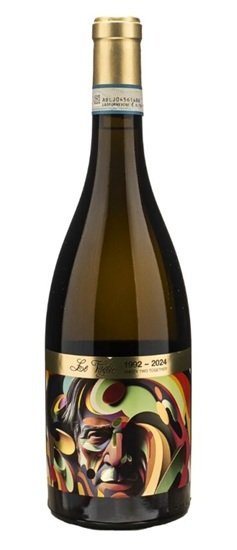 Verdicchio Castelli di Jesi Classico Le Vaglie 2024 Santa Barbara
Brilliant straw yellow with light golden hues. Olfactory profile played on ripe citrus, crisp pear and white peach, accompanied by white flowers, aromatic herbs and the typical fresh almond note of Verdicchio. The sip is fresh and soft at the same time, of medium structure but well laid out, with a dynamic progression supported by sapidity and good acid tension. Good balance between fruit component and almondy finish.
Production area: the classic area of Verdicchio dei Castelli di Jesi, in the hilly territory around Barbara, in the province of Ancona, in the inland belt but still influenced by Adriatic breezes. The vineyards are located about 250-260 meters above sea level, with mainly southeast and northeast exposures. The soil is tufaceous and sandy matrix, with good mineral presence.
Grape varieties: 100% Verdicchio, with upside-down espalier training system.
Production processes: vinification takes place in steel tanks with constant temperature control of 10-12 degrees
Harvest: Generally between the second half of September and the first days of October, with harvesting carried out during the coolest hours to preserve the acidity and aromatic heritage of Verdicchio.
Production processes: Soft pressing, fermentation in stainless steel at controlled temperature. Maturation exclusively in stainless steel on fine lees for several months, with subsequent bottle aging before release.
Alcohol content: about 13% vol.
Serving temperature: 10-12 °C. (Best to avoid too low temperatures, which would compress the aromatic component and typical almondy finish of Verdicchio).
Recommended pairings: first courses of Mediterranean cuisine, Adriatic fish, light broths, delicate white meats and vegetarian dishes. In particular, it works very well with preparations where vegetable sweetness and savoriness coexist, such as these paccheri.