

Fattoria di Fèlsina is celebrating a series of anniversaries with a double vertical tasting of its two signature wines. Nine vintages are compared in an ideal pairing of elegance and power, curated by Daniele Cernilli.
This year at the Fattoria di Fèlsina A number of anniversaries have coincided. The 60th anniversary of Domenico Poggiali’s purchase. Then the 40th anniversary of the release of two of the winery’s most iconic wines, the Rancia, which is now a Chianti Classico Gran Selezione, and the Fontalloro. Finally, the 80th birthday of Giuseppe Poggiali, Domenico’s eldest son. It was certainly a cause for celebration, and the party took place on June 10. The family gathered together, along with many guests, all in Fèlsina, in the area of Castelnuovo Berardenga, just a stone’s throw from Siena.
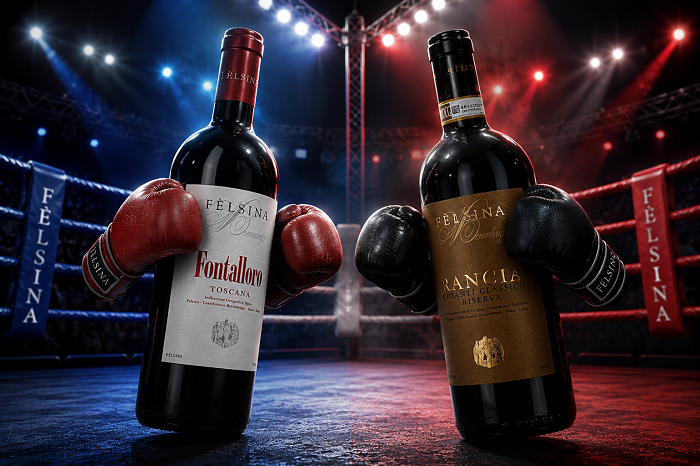
Nine vintages in the ring for a double vertical tasting
One of the most significant moments was the double vertical climb of Rancia and Fontalloro. A comparison of nine vintages. Rancia which came from—and still comes from—three vineyards located at different altitudes on the hill of the same name. Fontalloro which is made from grapes grown in three other vineyards—one in Chianti Classico and two just outside the region. As a result, it has been a Toscana IGT for years—one of the most famous.
The “conventional wisdom” has always held that Rancia is characterized by composure and elegance, while Fontalloro is vibrant and full-bodied. Both are now produced with 100% Sangiovese. In the past, up until the 1990s, the Rancia also contained a small percentage of other native varieties, but we’re talking about minor details here—just to comply with the regulations that required it at the time.
Leonard vs. Hagler
It was an exciting tasting, almost as exciting as the famous match between Ray Sugar Leonard and Marvin Hagler. On closer inspection, Rancia could have been Leonard—agile and elegant. Fontalloro was certainly Hagler—powerful and determined.
Let’s see how it went—at least on my personal record?
1985
The comparison begins with a historic harvest—hot and somewhat dry. The Rancia expresses this with class, agility, savory notes, and truly impressive aging potential. 41 years old and still going strong. The Fontalloro responds with more ethereal aromas and a flavor dominated by body and pronounced tannins.
In the end, Rancia wins the round, taking a 1-0 lead.
1990
A perfect vintage, ripe grapes, a little rain at just the right time—everything went well, in short. Here, the Rancia definitely takes the lead; its best qualities shine through and allow it to outshine an excellent but less elegant Fontalloro, whose tannins are still lively—perhaps even a bit too much so.
Rancia 2, Fontalloro 0.
1995
A late harvest, rain lasting until mid-August, and cool weather. Then a beautiful September and a spectacular start to October. The Fontalloro responds well, and the ripening of the tannins makes it more balanced than usual. The Rancia is remarkable, but this time it comes up short.
Rancia 2, Fontalloro 1.
2000
A hot, dry vintage with an early harvest. You might have expected a standout Fontalloro, given its structure and warmth. And indeed, that’s exactly what it is. But then there’s the Rancia—which you wouldn’t expect. Well-balanced, rich, velvety. It’s the clear winner, without a doubt.
Rancia 3, Fontalloro 1.
2005
A cool spring, delayed flowering and budbreak, and a long harvest. The Rancia is a bit less elegant than usual, with more pronounced tannins. The Fontalloro is taut and warm, with widespread but well-integrated tannins. It takes the round.
Rancia 3, Fontalloro 2.
2010
A great vintage. Balanced ripening. Spring rains and very hot July and August. The accumulated water prevented a drought. Rancia is rich and full-bodied; Fontalloro is simply exceptional—the best wine in the entire vertical tasting. Obviously, this round is his, and the score is tied.
Rancia 3, Fontalloro 3.
2015
A very hot vintage, even hotter than 2000. Fontalloro is a bit off its game, with noticeable tannins—perhaps a bit green. Rancia is in top form, just like in 2000. Enveloping, balanced, rich, and with great length. Rancia takes the prize.
Rancia 4, Fontalloro 3.
2021
A harvest of remarkable quality. Winter rains created good water reserves and prevented drought conditions. A Rancia that is slightly and strangely harsh, with tannins more pronounced than usual. The Fontalloro is better, with a body that better balances the polyphenolic richness. It takes this round. It’s a tie again.
Rancia 4, Fontalloro 4.
2023
A complicated vintage. Heavy rains through June, then very hot weather until the end of September, followed by more rain. The Rancia is struggling a bit—youthful tannins, a touch of astringency. It’s true, we’re at the beginning of its evolution, but… The Fontalloro is better, even if only slightly. Warm, full-bodied, with dense tannins and a hint of blood orange on the nose. This means the Fontalloro pulls off a comeback victory.
Final score, on my personal scorecard: Rancia 4, Fontalloro 5.
PRODUCER

