



At the Montepulciano 2026 preview, against a backdrop traditionally dominated by expectations for Vino Nobile, the panel discussion devoted to Rosso di Montepulciano allowed for a different and, in some ways, revealing focus on the appellation’s ambitions.
The decision to dedicate for the first time a round table (with tasting) exclusively to Rosso. Generation Rosso: the future of Rosso di Montepulciano in the vision of young producers – was not a symbolic gesture, but a political and cultural signal. Message is clear. Rosso can no longer be read as simply a “second wine,” but as a type with its own strategic horizon.
The discussion, moderated with grit and pace by Simon Staffler of Falstaff, brought together journalists and young producers-Jean Marco Palmieri. Francesco Saverio Russo, yours truly, Alessandra Piubello, Andrea Gori, and Raffaele Vecchione. “Paired” with the next generation by Poliziano (Francesco Carletti), Boscarelli (Sebastiano De Ferrari), Carpineto (Anton Zaccheo), Tiberini (Niccolo Tiberini), Le Bèrne (Federico Fastelli) and La Ciarlana (Matteo Frangiosa).
Many ideas were put on the plate, and the indications that emerged by linking critical gaze and new entrepreneurial generation helped to see Rosso not as a comprimario of Nobile, but as an autonomous identity project. The generational dialogue returned a compact image: the Red is now the typology that best intercepts the present.
The problem is how to succeed in conveying this vision to the outside world, turning it into awareness on the part of all actors in the system.
2024: enjoyability and stylistic precision
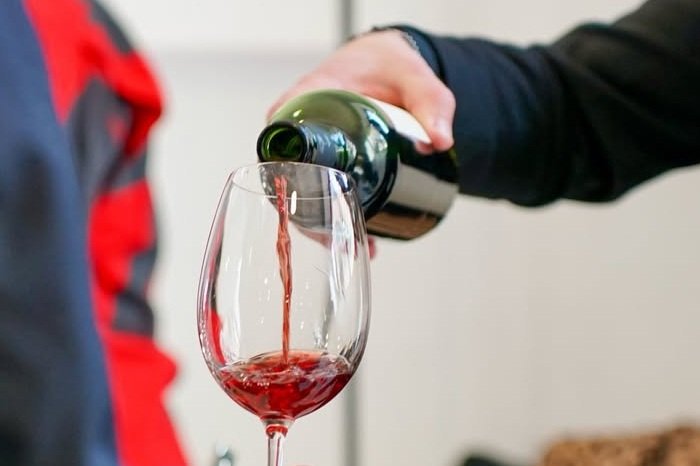
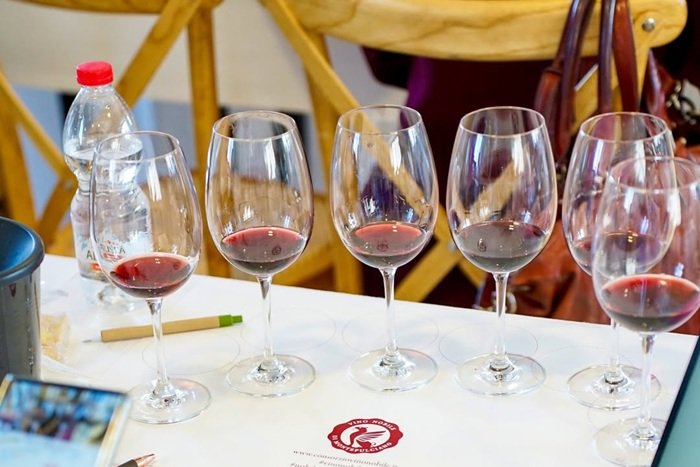
The Rosso di Montepulciano 2024s of the 6 leading producers. Aalthough in their different interpretations, stood out for freshness, fragrance and immediate drinkability. It should be remembered, however, that the wineries involved are among the best exponents of the appellation.
This immediacy is not a limitation, but a strength in a market that favors measured alcoholicity and drinkable agility. Net of quality, then, the real issue remains. Red’s knowledge and recognition outside the territory and the absence of a strong collective strategy.
Hence the idea of affixing a seal on the bottle with the glyph of Montepulciano (along the lines of the Chianti black rooster) really appealed to me, as did the proposal a common bottle.
The specification: change the rules or change the narrative?
The regulatory structure–minimum Sangiovese 70%, other grape varieties authorized in Tuscany, release from March 1 following harvest–enhances freshness and immediacy.
Someone suggested limiting complementary grape varieties to native varieties only, but – in my opinion – stiffening the composition too much would risk distorting a typology that thrives on fruit and pleasantness. In ready-to-drink wines, a small proportion of Merlot (found in many local vineyards), can promote balance and contemporaneity.
I also launched a provocation. To expand the appellation by including the white and rosé types with the “inverted” name, Toscana Montepulciano Rosso, Bianco e Rosé, so as to strengthen the territorial link and not leave these productions in the anonymity of Igt. A radical idea perhaps, but one that is consistent with the goal of increasing territorial recognition.
Rather, the real limitation of the specification was to have defined Rosso as a “spillover wine” from Nobile. Which has weakened its perception. If it is communicated as the “easiest Nobile,” it will remain subordinate. If, on the other hand, it is told as an authentic, agile and identifiable expression of Montepulciano, it can become one of the Tuscan types most in line with contemporary sensibilities.
It can become the bridge between classic Tuscan reds and a more modern version of the terroir. More affordable price, wide adaptability to dining-even by the glass-and ability to speak to young consumers are key elements.
The test bed of the denomination

Red is probably the wine best suited to interpret themes such as. sustainability, climate adaptation and “less but better.” less aging time, more direct style, the ability to enhance freshness and fragrance without chasing concentration and power.
The question is simple: is Montepulciano ready to invest in Rosso not only as a volume, but as a cultural project?
If Vino Nobile represents the history of Montepulciano, Rosso could be the energy. And it became clear from this roundtable that the time of its marginality is over. What is needed now is consistency: in average quality, in communication and in finally breaking free from the logic of “second wine.”

