
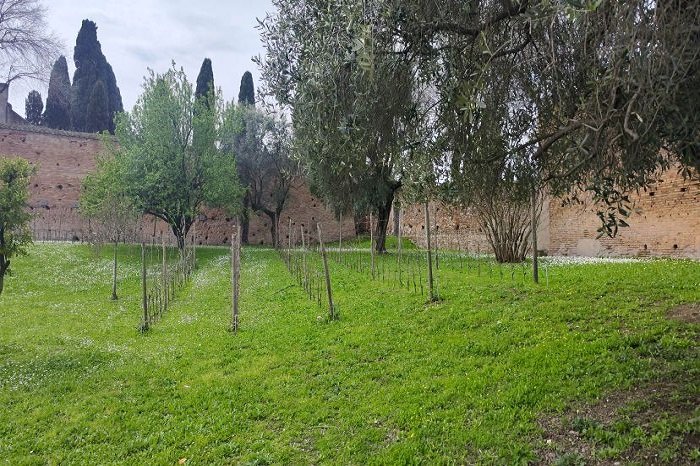

Within the Colosseum Archaeological Park there is a tiny Bellone vineyard (only 400 plants) that recalls the one created in the 17th century by the Barberini family. A historic site for an exquisitely cultural planting. Luciano Lombardi tells us about it.
In mid-February, walking around the Colosseum, we were going up the Via Sacra. On the left, beyond a shabby, tightly closed iron gate, inside a surprisingly collected green area protected by high walls, I glimpsed something unexpected: a small vineyard.
Few rows, but perfect. Groomed with obvious precision, the result of expert hands. Curiosity was immediate: whose it was, who had planted it, what vine variety had been chosen. Not just any vineyard, but perhaps one of the most unlikely in the world: a few steps from the Arch of Titus, the Colosseum, the Imperial Forums, In the heart of the Palatine, the ancient home of the emperors.
A curiosity satisfied
Back home, I started searching. Emails, phone calls, research. I thus discovered that Vigna Barberini belongs to the Colosseum Archaeological Park., and which was desired and designed by thearchitect Gabriella Strano.
I wrote to their press office to find out more. The response came quickly. And with it, a rare opportunity: to visit it accompanied by the very people who conceived it.
An exceptional guided tour
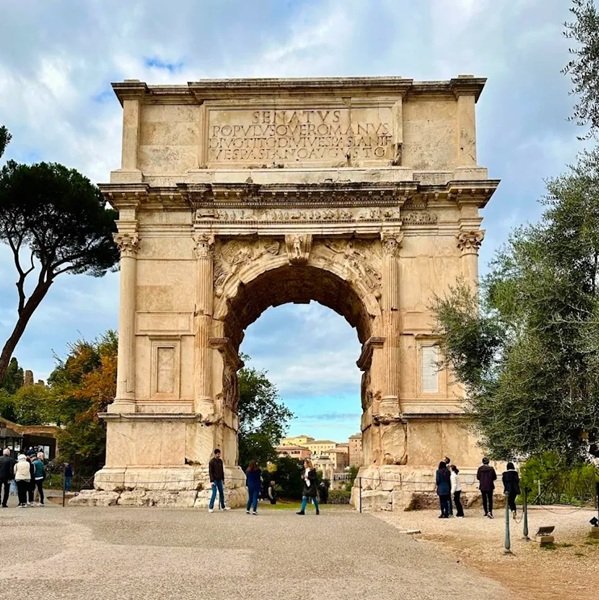 The rendezvous is for mid-morning under the Arch of Titus. From there it only takes a few steps inside the Colosseum Archaeological Park.: one enters a small tunnel, almost hidden under the Via Sacra, and in a few seconds one goes from the continuous flow of visitors to a silent, collected space: Vigna Barberini.
Architect Strano tells me that the idea came from a specific gesture: replanting a vineyard where already in seventeenth-century times the Barberini family had cultivated vines, giving back to the Palatine one of its most ancient and symbolic components. Not a decorative choice, but a cultural one.
A grape variety consistent with the territory: the Bellone
For the Romans, in fact, the vine was a key plant presence, along with the olive and fig tree: sacred plants, loaded with meaning as well as function. Hence, the decision to work on a grape variety consistent with the territory: the Bellone, a Latium variety of very ancient origin.
The winery was involved in the creation of the vineyard Cincinnatus, a reality based in Cori, the ancient Cora, with the direct support of its owner Nazzareno Milita and, for the design and communication aspects, Giovanna Trisorio. A necessary step to transform a design intuition into a royal vine planting.
But this is where the project gets complicated.
The difficulty of an implantation on the Palatine
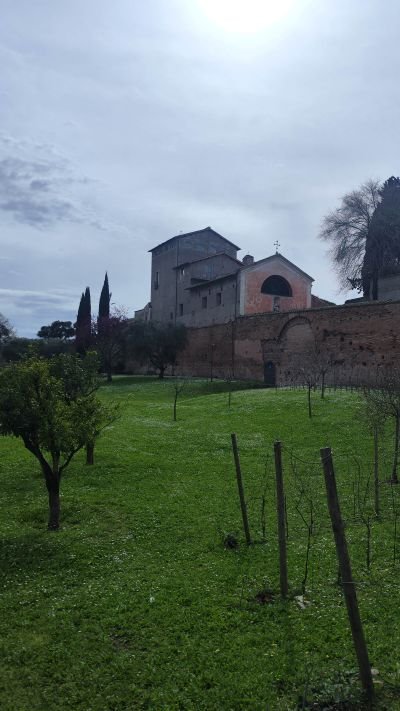
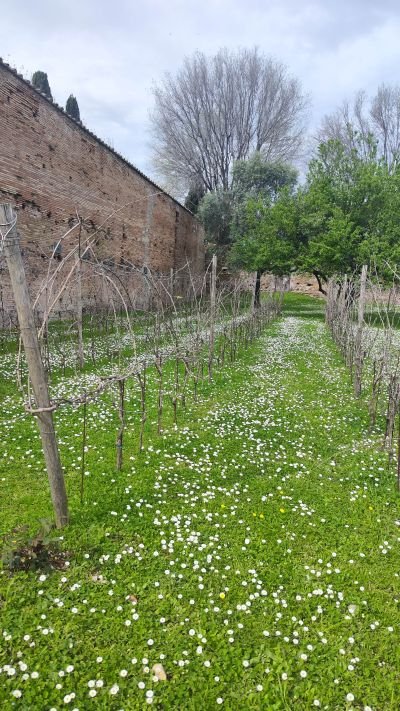
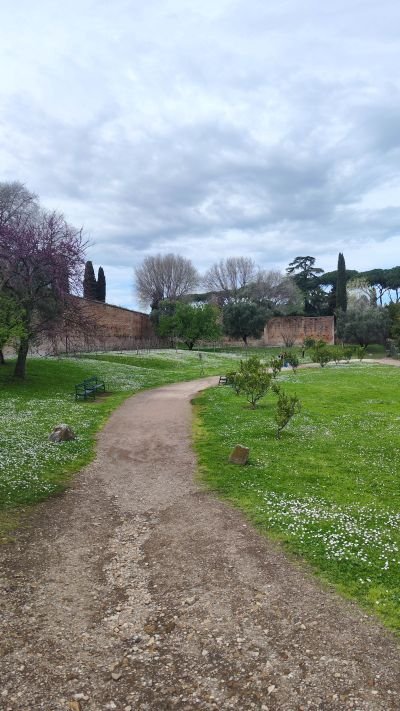
The Palatine is not agricultural land in the traditional sense. It is a layered system, built vertically over centuries. Beneath a few inches of earth develop environments, vaults, imperial structures Which cannot be compromised in any way. Vine roots, if left loose, could easily cross the surface layer and reach the underlying archaeological structures.
For this reason, the choice of area was decisive: the sunniest portion and, above all, the one with greater thickness of available soil. The result was an extremely restrained planting, a few rows arranged in an L shape, leaning against the perimeter walls. A technical solution, even before the aesthetic one.
Added to this is a little-visible but crucial element: the soil itself is partly made up of spoil from excavations in the area of the Temple of Heliogabalus. Ancient land, moved and relocated, returning to cultivation today.
A microcosm from the past
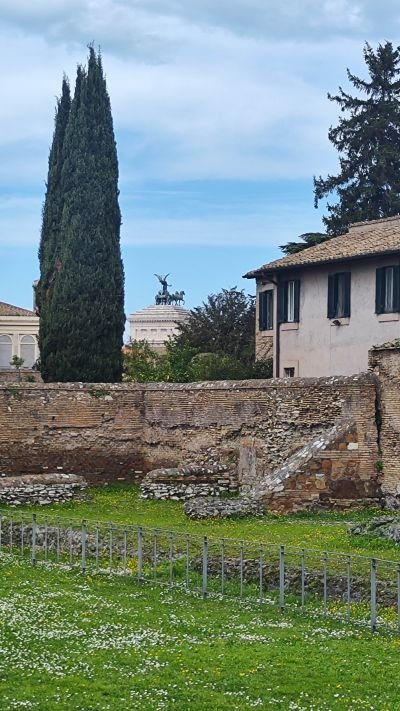
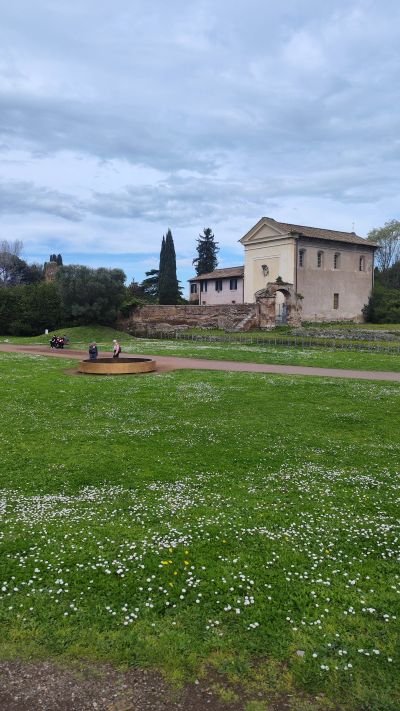
Looking closely at the vineyard, the nature of the project emerges clearly. The rows, still young – About 400 plants spread over eight rows – Are arranged in essential order. The support system uses chestnut wood poles, consistent with traditional techniques compatible with the historical context. Management is entirely manual, with rescue irrigation and limited phytosanitary interventions to a minimum, using products allowed in organic farming.
The soil is thin, spontaneously grassed, and immediately returns the feeling of a soil that cannot be forced. Vines grow here, but within precise limits, imposed not by traditional agronomy but by the need to protect what lies beneath. The rows run parallel to the perimeter walls, as if following an invisible line of security.
Next to the vines is a small, articulated plant system: fig, lemon and olive trees. At the ends of the rows, still young roses mark the rhythm of the vineyard, according to a sensibility that is both agricultural and design. The overall impression is that of a suspended vineyard, more leaning than rooted.
2023: the first, tiny vintage
 The first harvest was in 2023. The result: two bottles. A number that perfectly tells the nature of the project. With the upcoming harvests, a slight increase is expected, although there is no shortage of unpredictable elements: among them, parrots, which are particularly fond of ripe grapes.
The wine produced was called AVGUSTO, with a V instead of a U, according to Latin epigraphic usage. But it is above all the label that tells the deep meaning of the project. On it appears. A detail of the wall decoration of the House of Augustus. The juxtaposition is not decorative, but intentional: to create a visual dialogue between the wine produced today and the figurative apparatus of the Roman era. The bottle thus becomes a meeting point between two times, not a container but a narrative object.
2025 vintage and the contribution of the Cincinnati winery
For the 2025 vintage, it was also chosen to experiment with an aging in terracotta. A choice that is not technical in the strict sense, but cultural: to bring wine back to a material deeply linked to Roman tradition, seeking an expression more consistent with the place.
Cincinnati Winery ‘s participation in this project stems from a vision that goes beyond the production aspect. It is a form of contemporary patronage, a way of understanding wine not only as a product, but as culture, storytelling and a tool for reading the landscape.
AVGUSTO wine will never be put on the market. It has no price, no market. Like the oil produced from the Palatine olive trees, it is intended only for institutional settings. Production, here, is not the end. It is a consequence.
Return to the present
Leaving the Barberini Vineyard, one quickly returns to the Via Sacra, the noise and the continuous flow of visitors. But the perception changes. Behind that gate remains a place where the vine is not simply cultivated, but reintroduced. Not out of necessity, but out of memory.
And perhaps that is the most interesting point: not the quantity produced, nor the quality that is to come, but the very fact that, after centuries, vines have returned to the Palatine.