

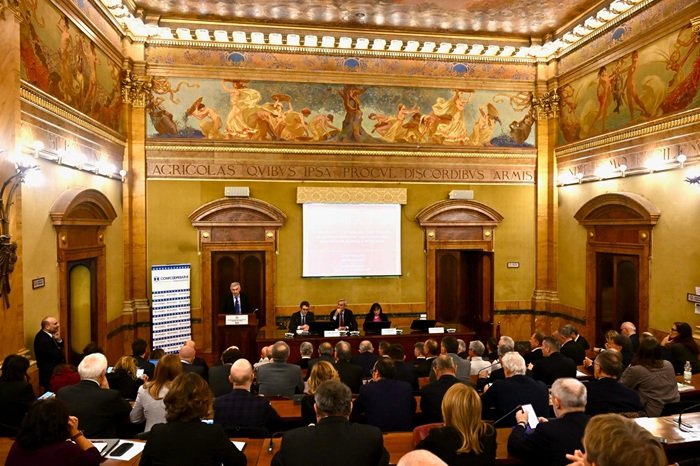
Relaunching the competitiveness of Italian wine: promotion, innovation and conscious consumption for the future of the CAP post 2027. Confcooperative debates the future of wine at the conference organized in Rome in the presence of Agriculture Minister Francesco Lollobrigida.
The future of Italian wine depends on a long-term strategy
Relaunch the competitiveness of Italian wine with a long-term strategy based on promotion, innovation and conscious consumption, while defending the sector’s strategic role in the future post-2027 CAP.
This is the call that emerged from the conference “Competitiveness and the Future of Italian Wine,” sponsored in Rome by Confcooperative Fedagripescawhich represents 264 wineries and consortia, with an aggregate value of more than 5 billion euros and about 40 percent of national wine production.
World production rebounds slightly, but consumption in mature markets falls
According to the latest OIV report, presented by Giorgio Delgrosso, Head of the Department of Statistics and Digital Transformation, world wine production in 2025 will stand at 232 million hectoliters, a slight recovery from 2024, though still below the average of the past five years.
However, overall consumption continues to decline in the more mature markets, especially for red wines, while the shares of whites, rosé and sparkling wines are growing.A clear sign, Confcooperative points out, of the need for Italian companies to adapt to new consumer tastes and transformations in international markets.
Rigotti: “A strategy is needed, not the pursuit of emergencies.”
“The future of Italian wine,” said Luca Rigotti, president of the Wine Sector of Confcooperative, “will depend on our ability to build targeted policies, not on chasing emergencies. In the proposed CAP reform, the wine sector risks a significant paradigm shift. Wine sector intervention, now mandatory for member states, could become optional, leaving it up to individual countries to decide whether and how to activate it. Wine cannot lose its identity nor its strategic role within European agricultural and economic policies.”
Rigotti also highlighted the importance of promotion as the main lever for competitiveness. Among the proposals accepted by the European Parliament, Comagri approved the increase from 50 percent to 80 percent of funding for promotional programs and the removal of time limits for campaigns in different countries. “This will allow us to strengthen the brand of Italian wine in the world,” he concluded.
Innovation, sustainability and research: the keys to staying competitive
Rigotti then recalled the need to invest in innovation and research:
“The market is changing rapidly. It is time to experiment with new types of products, from dealcolated wines to those with low natural alcohol content, always in the name of quality and sustainability. Only in this way can we strengthen the reputation of Italian wine and guarantee a future for our wineries.”
Wine and health: a symbol of the Mediterranean food model
On the topic of the relationship between wine and health, Raffaele Drei, president of Confcooperative Fedagripesca, spoke, commenting on the report by Professor Attilio Giacosa, president of IRVAS (Institute for Research on Wine, Food and Health).
“Wine,” said Drei, “cannot be equated generically with alcoholic beverages. It is an integral part of Mediterranean culture and diet, a symbol of balance and conviviality. We must counter with the rigor of science the alarmist messages that undermine the image of the sector and misinform consumers. Abuse is harmful, but moderate and conscious consumption is part of our food identity and well-being.”
Defending the strategic role of wine in the CAP and the Italian economy
Drei concluded with a strong political appeal:
” Italian wine cannot resign itself to happy degrowth or be marginalized in CAP reform. Italy is a world leader in all segments-from heroic vines to sparkling wines from the Northeast, via the great DOCs-and is the only country with such a wide biodiversity. We need a new supply chain policy, supported by adequate resources, effective promotional tools and a regulatory framework that recognizes wine’s strategic role in European agriculture and economy.”

