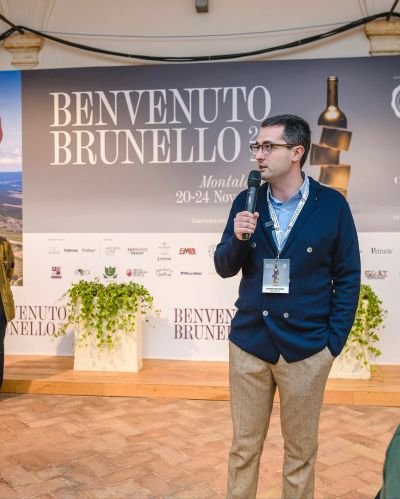
At Benvenuto Brunello, the Montalcino preview dedicated to new releases, Brunello 2021 reveals itself to be a complex vintage with a wide qualitative range. Amid novelties and new “contemporary” trends that risk distorting the wine, Riccardo Viscardi reaffirms one point: true Brunello lives on harmony, matter and territory.
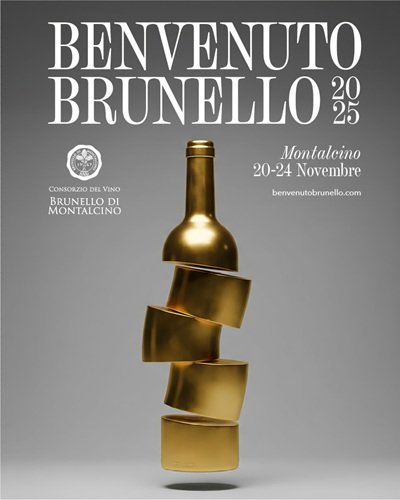
November 2025: Cold, rainy days frame the event that presents the world with the new vintages of Brunello, on the market from January 2026. In the tasting were the Brunello 2021 “vintage”, the different 2021 and 2020 selections and vineyards, as well as the 2020 Reserves.
We also tasted the eight Moscadello present: a wine with ancient historical roots, documented in Montalcino well before Brunello. I Rosso di Montalcino, however, will have a dedicated space later in the year.
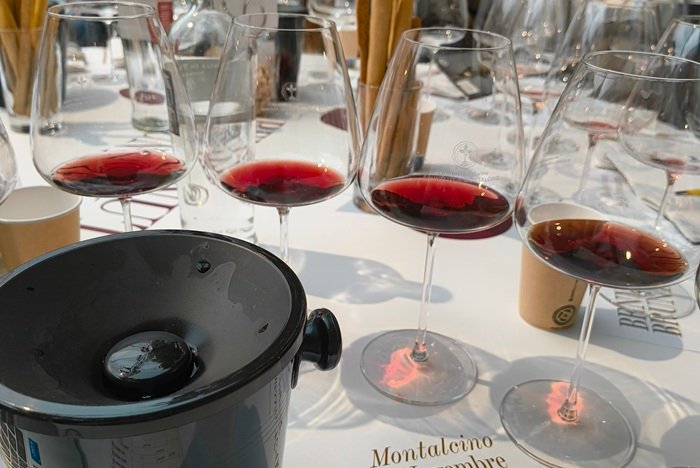
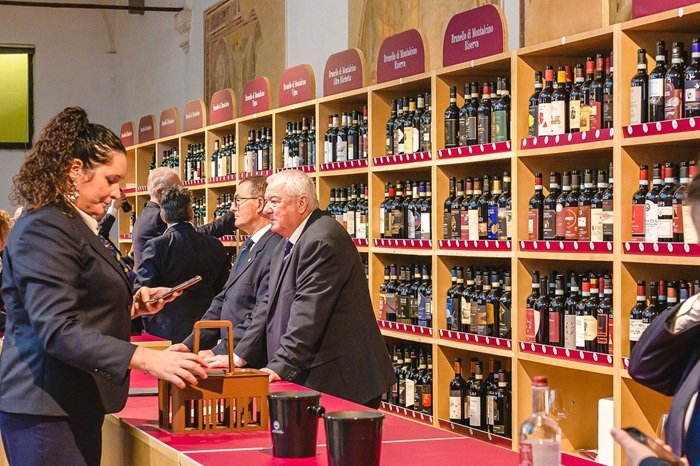
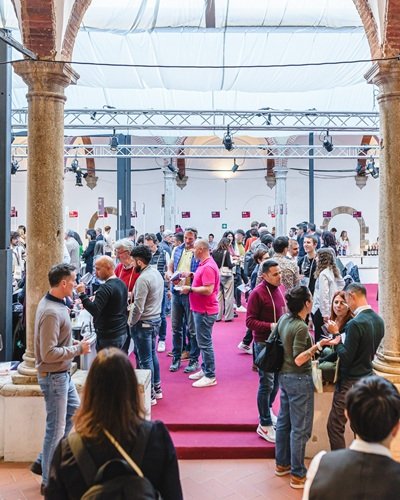
Inside the carefully air-conditioned cloister, the temperature was ideal, with the right compromise between human comfort and the need for wine. The service – impeccable in timing, precision and professionalism – allowed us to taste all the labels in the tasting.
Some color novelties
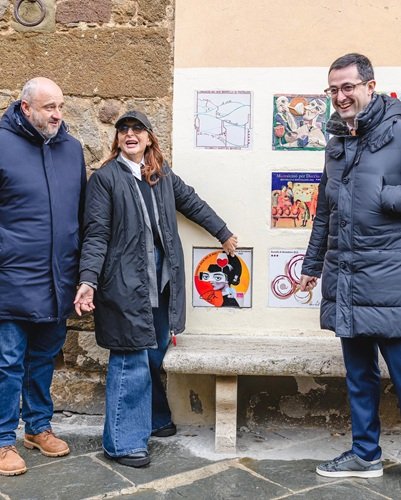
As was the case last year, the Consortium no longer assigns the traditional star rating for the vintage. Fortunately.: by now we almost always ended up with vintages of 4 or 5 stars, a scale that has become unremarkable. Instead, the laying of the tiles of the thousandth, a successful and much appreciated initiative.
In fact, an evaluation continues to be there, but the method with which it is expressed. “With Brunello Forma, introduced last year, we inaugurated a new approach to reading vintages, going beyond the traditional star system to adopt an evaluation in a more qualitative and stylistic key, capable of best expressing the personality of Sangiovese.” comments new consortium president Giacomo Bartolommei. For the curious, it is evaluated not the last vintage (which would then be 2025), but the upcoming Brunello vintage, then 2021, according to several parameters. This year’s assessment speaks of a “fragrant,” “defined,” and “vertical” vintage.
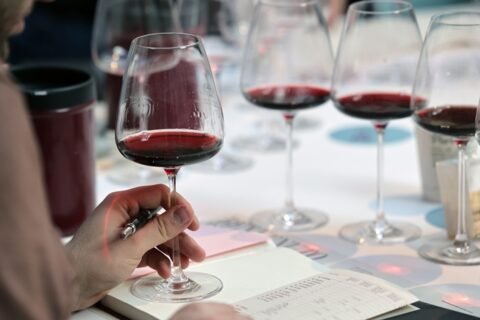
My reservations about the glass
The second note – also a confirmation from last year – concerns my personal dislike of the new glass adopted by the Consortium for tastings. The base is too wide and does not allow an adequate level of service: the wine, in the goblet, often appears visually “drained,” almost discolored. Moreover, this glass tends to favor the development of tertiary aromas, as admitted by the designers themselves: in fact, it was made at the indication of the representatives of the Consortium precisely with the aim of enhancing that aromatic register.
Rather singular demands by the technical commissions, which perhaps did not take into account the work – long and complex – that many producers (among the most representative, judging by the national and international scores) have been carrying out for more than fifteen years: to preserve the fruity notes, particularly cherry notes, longer in Brunello. A challenging concept, a road certainly not within everyone’s reach.
The participation of producers
There were fewer producers attending the event than last year, with an increase in defections, even among important names. There was, however, one notable return: The Potazzine, finally back among the participants.
This situation prompted us to organize a small “pre-welcome” tour to some absent producers, whom you will later find mentioned in the best tasting lists.
For President Bartolommei it will not be easy to recompose this diaspora. We, however, have confidence in him: he is young, balanced, technically very prepared and knows well the human fabric of Montalcino, marked-in the last consortium elections-by decidedly bitter contrasts.
Brunello di Montalcino 2021
Now let’s finally talk about Brunellos 2021. It is a vintage that the producers “pushed” with great enthusiasm, but which in the vineyard actually turned out to be complex and far from simple. This is precisely why it highlighted the abilities of the best and, conversely, highlighted some shortcomings in other cases, with a very wide qualitative range.
Montalcino remains an extraordinary territory for Sangiovese, which is its interpretive tool. Also this year, thanks to the mediation of the science and to expertise of man, some true masterpieces were born.
Current trends
In recent years a number of trends in the interpretation of Brunello have been emerging with increasing evidence, and some of them leave us rather perplexed. One in particular – fortunately still a minority – worries us not a little.
I am referring to the choice by some producers to lighten and simplify the Brunello, sometimes even going so far as to strip it down, following the idea of a “contemporary” Brunello. A word, however, that risks turning into an empty, almost demagogic container, because it is rarely accompanied by a real debate about its meaning and how it can apply to wines and territories with a long, articulated and highly successful history.
What I find difficult to comprehend is that, in Montalcino, a “contemporary” wine-at least in today’s most popular meaning of “light”-already exists, and it is called Rosso di Montalcino.
Ilcinese materiality
 What has made Brunello famous in the world is its ilcinese materiality, which has nothing to do with merely “muscular” tannin. When it lacks that particular pathos expressive, the tannin ends up being overemphasized and, at the same time, a preeminent alcoholic sensation, with a finish that dries out and closes quickly.
It is precisely this combination that we found in some of the Brunello 2021 referred to as “contemporary,” and which we don’t like at all: because it ends up losing the origin in favor of a productive method (or ideology).
Harmony, not subtraction
The great Brunellos manage to hold together alcohol, tannin and matter in an intense harmony, making them both drinkable and fascinating. Then if someone does not like this balance because they perceive it as “too much,” they can legitimately turn to other appellations based on the same grape variety.
The importance is harmony, elegance that comes from a composition of elements that are intense and therefore more difficult to achieve.
Boxing also helps explain the idea. The elegance of Muhammad Ali, Joe Louis o Larry Holmes was different from that of Marvin Hagler, Sugar Ray Leonard o Floyd Mayweather: belonged to different categories (it only takes a few pounds to change everything).
And for that very reason, that elegance was even more admirable: it is not a unique pattern, but a balance achieved within a body, a weight, a specific power.
Brunello: when balance is born
I am reminded of a “confession” that, at different times, two winemakers who had just arrived in Montalcino to start new collaborations made to me. Both expressed the same concept: “During fermentation you worry: the extracted tannin seems too much, the alcohol maybe too much. Then you put it in wood, summer passes, and everything harmonizes, rises in level, takes volume. The result is an intense elegance, so different from Chianti Classico and Nobile. This is a territory.”
In other words, in Montalcino, balance is never “easy” or immediate: it is a process, and it is an integral part of Brunello’s identity.
Territory creates differences, but it cannot be ignored
It is the territory of Montalcino itself that generates within it even considerable differences, yet recognizable. A classic example: comparing the Brunello Pianrosso of Ciacci Piccolomini d’Aragona with Baricci’s Brunello means finding two interpretations that are also far apart, but with a fixed point: Montalcino remains evident.
This is its genius loci: it cannot be disregarded.
The real “contemporary” Brunello
Therefore, in our opinion, the true contemporary Brunello is not the one that disavows structure in pursuit of an abstract idea of lightness. Instead, it is the one that builds gustatory and olfactory balances capable of reflecting the territory, with its unique and recognizable landscape units.
The risk, otherwise, is to bend Montalcino to a “personal vision” of the grape variety, ending up abandoning the territory-and thus the origin.
Below you will find a list of 12 Brunello 2021 and 6 Brunello Riserva 2020 that amazed us (we avoided reporting the same producer for the two types) and then 2 magnificent Moscadello di Montalcino just to remark origin, territory and tradition.
The Brunello di Montalcino 2021 (looking for the territory)
- Casanova di Neri Giovanni Neri, score 98/100
- Siro Pacenti Vecchie Viti, score 98/100
- Salvioni, score 98/100
- Baricci, score 97/100
- Valdicava Montosoli, score 97/100
- Altesino Montosoli, score 96/100
and Brunello di Montalcino 2021 (consortium tasting)
- Argiano Vigna del Suolo, score 97/100
- Canalicchio di Sopra Vigna Montosoli, score 97/100
- Giodo, score 96/100
- La Magia Ciliegio, score 95/100
- La Fortuna, score 95/100
- Poggio Antico Vigna I Poggi, score 95/100
Brunello di Montalcino Riserva 2020
- Il Marroneto, score 98/100
- Ciacci Piccolomini d’Aragona Vigna di Pianrosso Santa Caterina d’Oro, score 97/100
- Hut, score 96/100
- Fuligni, score 96/100
- Patrizia Cencioni, score 95/100
- Tiezzi Vigna del Soccorso, score 95/100
Moscadello di Montalcino
- Capanna Vendemmia tardiva 2020, score 95/100
- Col d’Orcia Vendemmia tardiva Pascena 2019, score 92/100